
Lyndall Robinson — Engineering & Design
Evolution | Parlee
“I don’t really think in terms of stiffness targets. I think about load paths—how forces move through the frame, how they change over time, and how the bike is going to feel hours into a ride, not just in a single moment. Carbon gives you the ability to tune that, but it’s not formulaic. It’s more like woodworking than metalworking. Small changes in orientation or layering compound very quickly, especially where the tubes meet. That’s where the real work is.”
Lyndall Robinson is Production Manager at Parlee. She works at the center of how the bikes are conceived, tuned, and ultimately brought into being. Trained as an industrial designer and engineer and deeply fluent in carbon fiber construction, Robinson translates abstract ideas about ride quality, durability, and performance into layups, junctions, and manufacturing decisions. Her work is less about hitting numbers than about shaping how a bike behaves over time, across conditions, and under real riders. In our conversation, she speaks of carbon fiber as a living material, the complexity hidden within frames, and the craft that goes into making a Parlee.
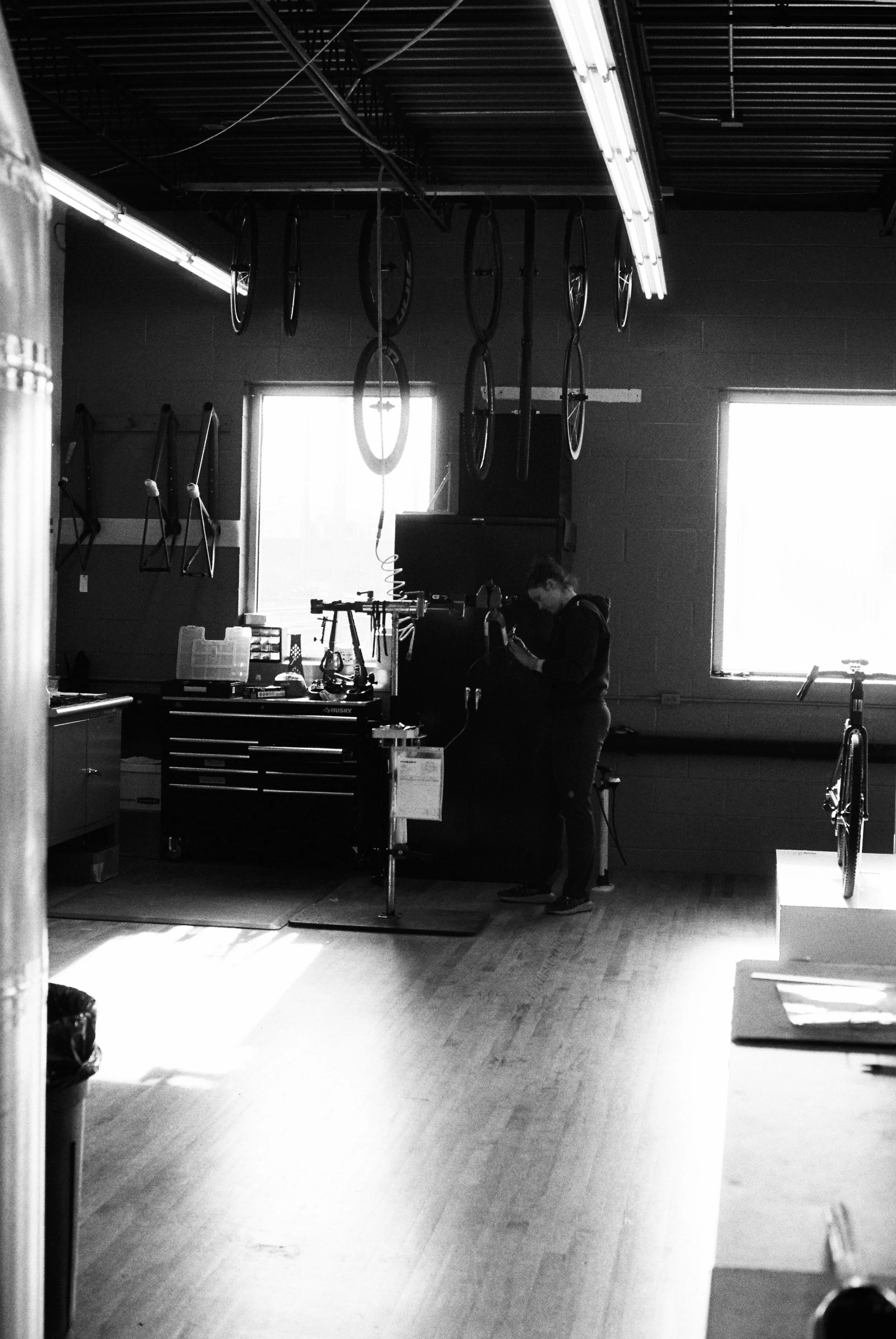
Can you introduce your background and how you found your way to Parlee?
I went to the University of Kansas for industrial design. I studied abroad in Australia, came back, and school just didn’t feel the same. I ended up running a Kickstarter in Alabama building bicycles—carbon, bamboo, fiberglass—and that became my last year of school instead of being a traditional student. It was under an umbrella called Hero Bike.
I ran a few Kickstarter projects through there—two bicycles, a couple different skateboards—and focused a lot on different ways of manufacturing. That was my first real dive into carbon fiber and bicycles. After that, I built my own bike, and I got picked up by Parlee Cycles and moved out here.
What’s your role at Parlee?
Overall, I’d describe it as operations and fabrication management. I facilitate orders through the entire custom factory process—everything from the carbon build, to paint and then out the door. I’m also very involved in engineering the carbon fiber layups and I still build parts. Every bike that goes out is touched by me at some point.
Where do you see Bob’s legacy showing up most clearly right now?
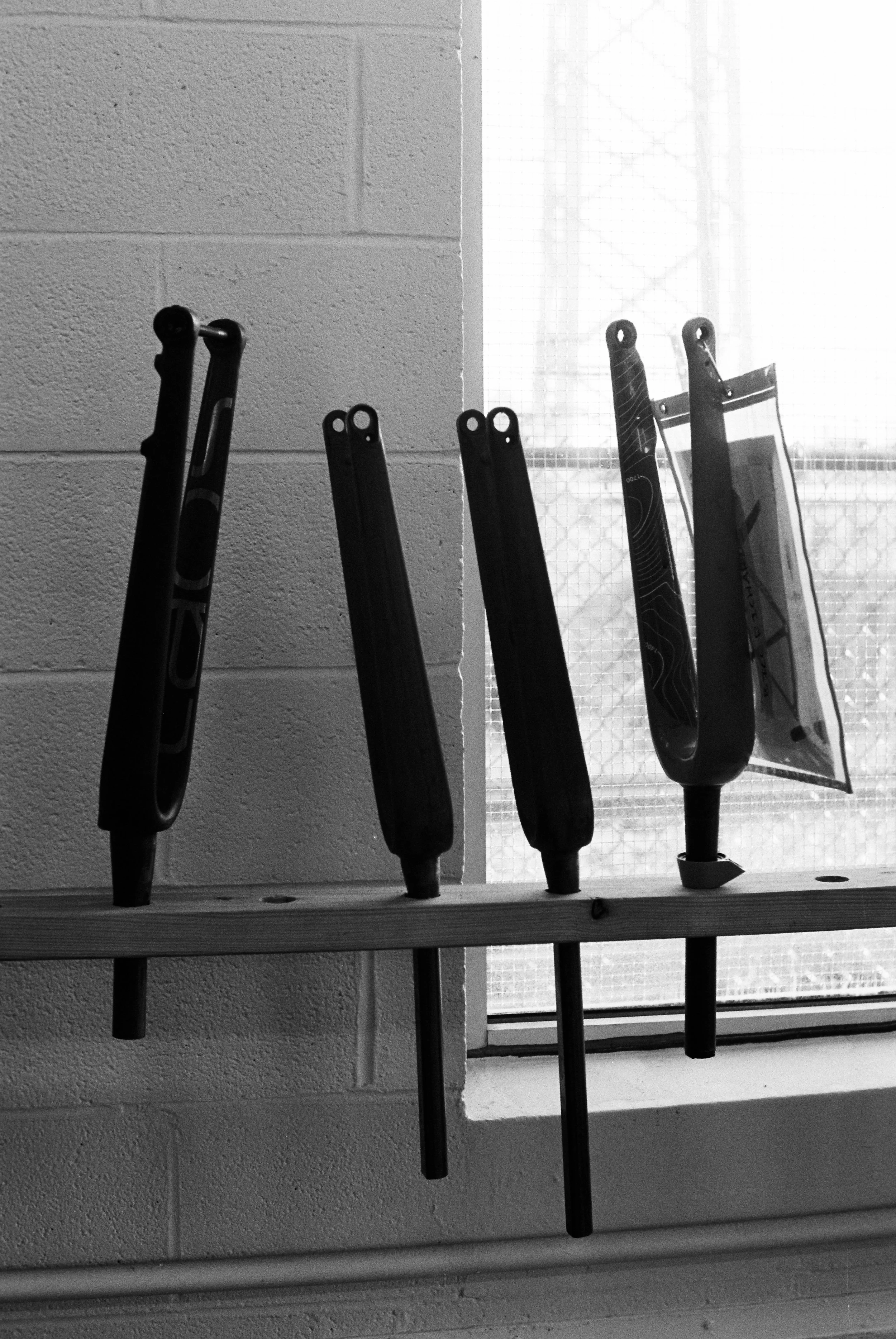
The new GT fork, honestly. As a technology piece, building forks for the new GTs here is a pretty big feat for us. And I have to personally say I took a lot of what Bob taught me and transcribed it into how I make the fork.
Bob did a lot of layup design for typical round tubes, and I worked a lot with him on that. So I took knowledge we developed together and implemented it into the fork. And then there’s his testing process—iteration, and just keeping going.
The layup has over 180 pieces. Compared to something like a top tube—your top tube has 8 to 12. So you can think about how many different directions that is, and how much that changes ride quality and dampening.We built 25 different forks, tested all of them, and tried to understand what was going to ride the best. It was quite the process.
What is the guiding principle when you’re engineering these parts?
Comfort is king or queen. And then from there, the ability to fit so many different types of people on this bike. Our process is so different from other companies, we have the capability to build the bike that is going to fit you, no matter what.
How bespoke is the bespoke process, really? If someone orders a GT, what changes?
It’s hugely bespoke. Everything from working with the dealer, getting a fit, choosing paint or not—it’s completely bespoke. It’s a long process, but everybody gets their dream bike in the end.
We’re looking at rider weight and fit, and then what the rider wants to do. Gravel riding, road riding going fast, endurance and leisurely rides—there are so many different things. We have a tube set for each different kind, based on height and weight. Even the way we put all the tubes together.
If you want something specific—like a really stiff bottom bracket—we can make a stiffer bottom bracket for you in our molding process.
We’re hoping that from the time I get the order from the dealer, it’s like 60 to 90 days. And as far as a custom bike goes, that’s exceptional—especially given we’re building everything: the fork, the tubes, the derailleur clamps. We’re building all of it in-house here.
How big is Parlee right now?
We have twelve people.
From a materials and manufacturing standpoint, how do you actually build these bikes?
Everything we use is prepreg. I try extremely hard to never do wet layup. It creates messes. We’ve done it on many different things, but resin gets everywhere.
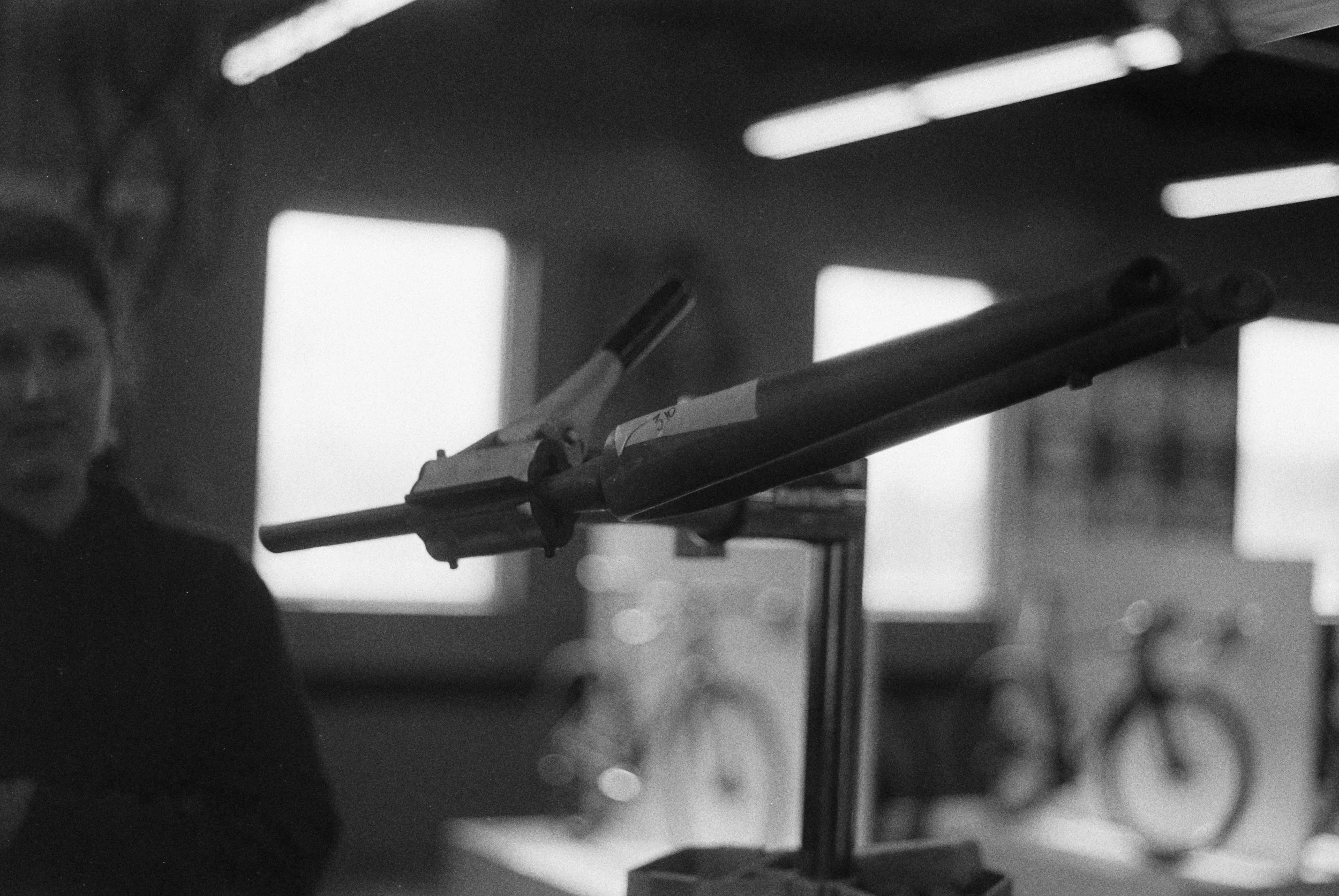
We use prepreg, and we have four different types of carbon fiber that we’ll probably put in every single tube—different directions, obviously. We have our Automatrix, which is a huge lifesaver. It cuts out all the pieces instead of us hand cutting everything, which we were doing. We were probably doing that like seven years ago. It was horrible.
The thing that really differentiates our ability to make such a custom bike down to the millimeter is our molding process after the tubes are made.
The whole bike is carbon fiber. We’re not even putting any inserts in besides the rivnuts for the bottle cages at this point, which is pretty unheard of. Now that we have direct mount, there’s no inserts in the dropouts.
And our molding process—there’s no glue, there’s no foam. It’s literally just carbon on carbon. That’s what makes the ride quality so great. It’s one of the reasons, of course. But we can get down to the millimeter, and that’s kind of our technology.
How do you feel Parlee’s place in Beverly and New England more broadly, shape the brand?
Resilience. I feel like a lot of people around here are resilient, and Parlee Cycles has been resilient.
We base everything on really hard work—extra time, making something perfect for a customer. And Bob and Isabel keeping all of us here for so long, still making bikes. It’s pretty neat.
And there’s a different riding culture up in New England. They ride through the winter. They’re rugged. It’s definitely different than where I’m from.
How long did you work with Bob before he passed?
About ten years.
What do you see as his legacy inside Parlee?
Within the business, he has a huge legacy as kind of one of the forefathers of carbon fiber bikes. He was doing it in a way that was so different from everybody else for so long.
Small businesses are hard, but it gave us such a foundation to work from. It was just because he wanted a new bike that felt better than everybody else’s. He couldn’t get what he wanted, so we made it.
And I think that’s what we hope our customers are coming to Parlee for. They can’t get what they want anywhere else.
He was also a problem solver. And I think Parlee Cycles—we’re really good problem solvers, especially in fabrication. We can figure out how to make almost anything. That’s a direct correlation from Bob and his legacy.
Can you give an example of that problem-solving mindset in action?
We built a bike for a really big NFL player—around 6'8", like 380 pounds. The tubeset needed to be able to hold a huge load.
And at the same time, we were building a bike for a woman who was 4'11". We were literally able to put her frame through his.
We had to make sure the layups were correct. That’s the work—problem solving those situations. We’ve made step-through bikes before when someone needs them. You can pretty much make anything in carbon fiber if you spend enough time figuring it out.
What has it been like inside the company since Bob’s passing?
It’s a huge hole. For a lot of us who were here for a long time.
Bob and Isabel were great. They took everybody in like family. Me personally moving across the country and not knowing anybody—they filled a big void there.
I miss him when I am working on my fork.
What has changed in the work since he’s been gone?
It’s funny, because we still do a lot of things the way that he would. We all learned carbon fiber from him. We’re essentially continuing his legacy.
But there were a ton of things in that last year—like the fork, thinking about handlebars and stems—ideas we had been talking about with him for years, and we’ve just been able to implement them now.
Technology has changed, so we’ve had to adapt—direct mount, new chainstay for the GT.
And we introduced bikes that we’re making in Portugal in that time period.
How do you think about the Portugal-produced bikes in relation to the bespoke bikes made here in Beverly?
The Ouray and the Taos are being produced in Portugal. They’re not entry level, but they’re not bespoke in the way the custom bikes are.
We still do some customization because we have the capabilities here—finishes, and we have a pretty good size range. And we also do customization on crank length, stem, handlebar, setback seatpost—stuff like that. Dealers can order them in a way that’s more tailored. But the sizing is standard—extra small through extra large.
Does the vibe of the company feel different now?
I’d say 50/50. There’s definitely a new vibe when new people come in. Priorities change—stock bikes, custom bikes, trying to mesh those together, what’s best for the company.
But the underlying goal to create the best bikes is still the goal.
You have a lot of responsibility here, and you’re also one of the few women in this kind of role. Do you think about that much?
It depends. Here, I’m pretty ingrained in the system, so it doesn’t really cross my mind day to day. There are situations where you notice it more—if someone doesn’t know who I am yet and I’m at a shop or something. But it shifts once people know.
What are your goals going forward—personally, and for Parlee?
For the brand: continue to improve our process. I always want to innovate what we already have. I’d love to come up with new custom bikes, start making handlebars, stems—build the company so that it’s more like us, and we’re not getting all this other componentry from other people. It would be really cool to do that.
Personally, I want to work more on the fork. It’s passing everything, but you always want to make it lighter. And when I make my personal bike, what can I do there? How can I take what I want for myself and implement it into what other people might want?
That’s one of the neat things about the fabrication team. We always think of things we want to try on our bikes first. And if it’s really cool and makes the bike different, we start to offer it for customers and improve everything all the time.
That’s where the whole company started. That’s the legacy.
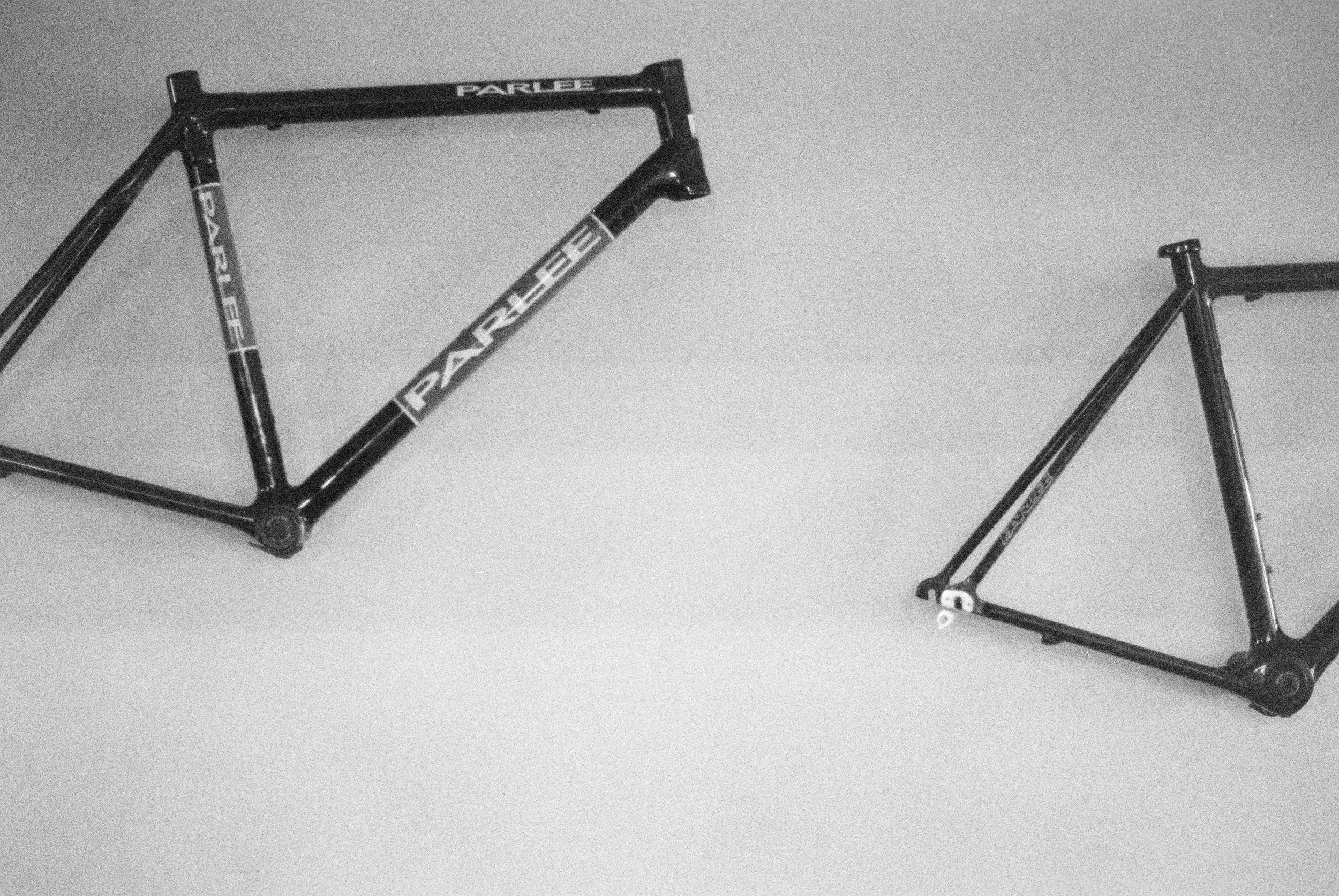
Parlee is a high-performance bicycle manufacturer headquartered in Beverly, Massachusetts.
Written by Chessin Gertler with Lyndall Robinson | Photography by Chessin Gertler