
Tom Rodi — Engineering & Product
Evolution | Parlee
“Bob and I sat down and tried to break comfort into measurable components—vibration, fatigue, deflection, frequency response. I think we ended up with something like twenty-five different indicators, and even then it felt incomplete. We argued about it. We kept adding things. Eventually it kind of collapsed under its own weight. Not because comfort isn’t real, but because it’s experiential. You know it when you ride it. And if you design around that long enough, you start to trust feel as much as data.”
Tom Rodi has been with Parlee for more than two decades in a variety of roles. He worked alongside Bob Parlee through the company’s formative years and remains deeply involved in how Parlee frames are conceived, evaluated, and evolved. Rodi’s perspective is shaped by long exposure—to materials, to riders, and to the slow feedback loops that reveal themselves over years of experience. Where others speak about performance in snapshots, Rodi thinks in timelines. In our conversation he reflects on comfort as a measurable but stubbornly elusive dimension of performance, and on the difficulty of reducing embodied experience to numbers.
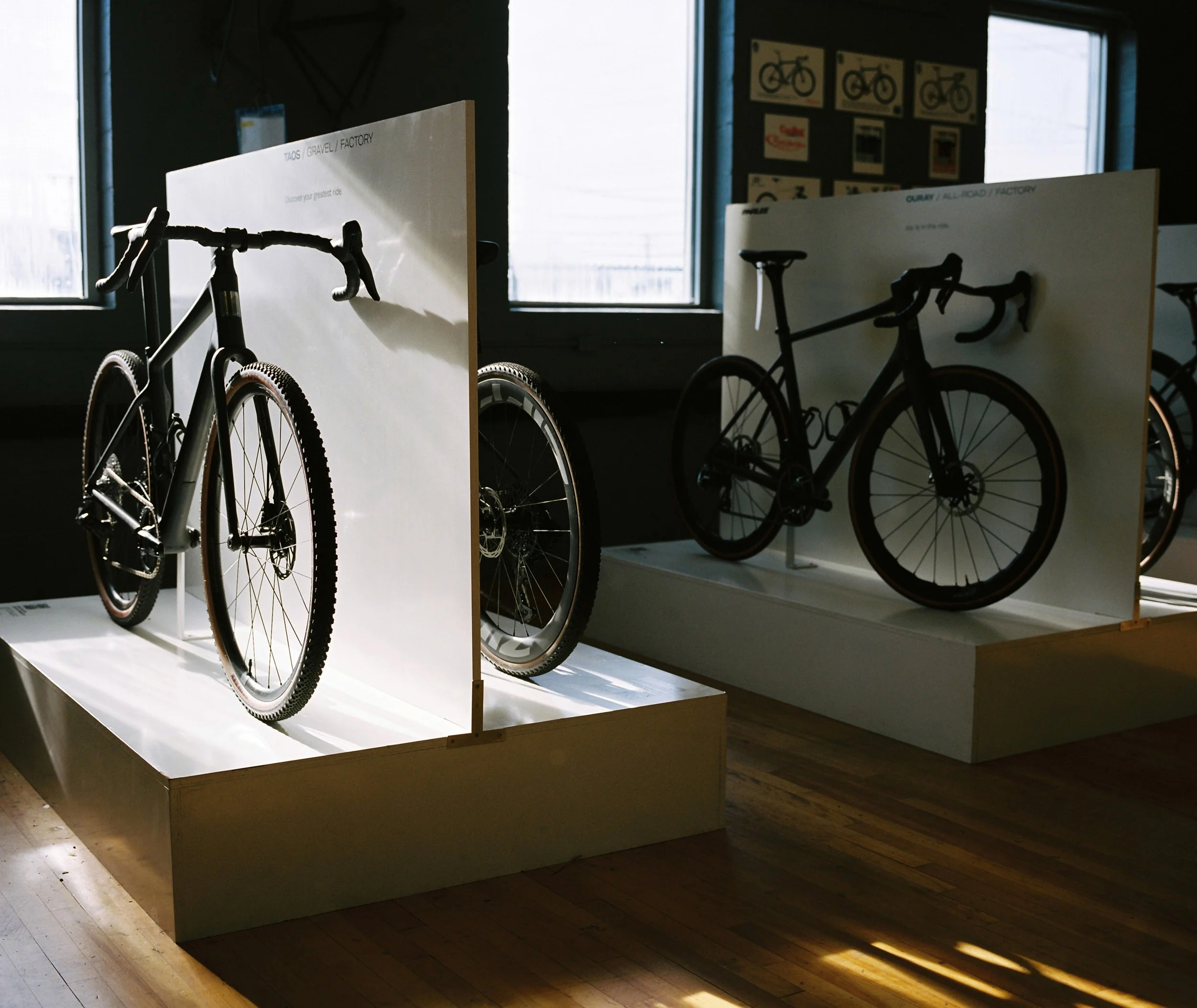
Can you introduce your background and the path that brought you to Parlee?
I’ve been with Parlee since 2003. I worked in bike shops all through college to pay my way. I didn’t have money for nice bikes, so I worked on my own. Eventually I got this crazy idea that I was going to make my own frame. I was lucky—I had an art professor who indulged that idea as an independent study. He was a painter, but he loved mechanical things, had an old Bugatti, had bought a handmade steel bike decades earlier. He understood craft.
After school, I didn’t really know what to do. In the mid-’90s it felt like all the bike industry was in Europe, Colorado, or California. I ended up working in tech for six or seven years, which is how I landed in Massachusetts, working out in Hopkinton in data storage.
But even then, I was still making bikes. Nights, weekends—I had a shop in my basement. I was welding, brazing, taking machining and welding classes, learning CAD. After 9/11, the tech bubble burst, and around 2002–2003 my wife and I took some time off. I decided I was going to hang out my own shingle and build steel bikes.
That was a hard time. Steel bikes were really dying then—this was before the handbuilt renaissance. I was trying to build bikes, sell them, do everything myself. My wife finally said, very wisely, “You should go work with someone who’s already building bikes.”
I had heard about this guy in Peabody—Bob Parlee. I knew he’d built bikes for Tyler Hamilton, but that was about it. I saw an ad that they were looking for part-time help. I came up, started working part-time, and that was it.
Was there a moment when you knew Parlee was different?
Completely. The first time Bob explained what he was doing, and then I rode one of the bikes—it was like that Indiana Jones moment when they open the Ark, or the suitcase in Pulp Fiction. I’d ridden a lot of early carbon bikes and honestly didn’t think much of most of them.
That ride felt like seeing the future. I realized immediately that steel—what I had been romanticizing—wasn’t the whole story anymore.
What was different about that ride compared to other bikes you knew?
At the time, you kind of had trade-offs. Aluminum bikes were stiff and fast on smooth roads, but brutal the moment the pavement got bad. Steel and titanium had comfort and liveliness, but you gave up weight and stiffness.
Bob’s bikes somehow ticked all those boxes. Light like carbon. Stiff where you wanted it. Comfortable and lively like steel. It felt impossible. And they were still significantly lighter than anything comparable at the time.
That was the “trifecta” moment for me. I’d ridden enough bikes to know that wasn’t normal.
How did Bob achieve that when early carbon bikes often didn’t necessarily ride well?
A lot of early carbon was what Bob used to call “black aluminum.” Light, but generic. The layups were simplistic—mostly fibers at 0 and 90 degrees, very little off-axis fiber. That gives you a stiff structure, but not a nuanced one.
With composites, you’re literally making your own tubes from nothing. Even if two people start with the same roll of carbon and the same mold, they’ll build completely different tubes depending on how they place the layers. Down tubes, top tubes, stays—they all want to do different jobs.
Bob was one of the first to really lean into that. He also pushed tube diameters up—larger tubes with thinner walls—which was closer to aluminum sizing, but applied thoughtfully with carbon. That combination mattered a lot.
And then there’s how the tubes are joined. That joining technique—how loads flow through the joints—has evolved over 25 years, but it’s still fundamentally different from most of the industry.
People used to say things like, “This carbon bike reminds me of my steel bike.” That was huge for us. Comfort, liveliness, and still better climbing performance and much lower weight.
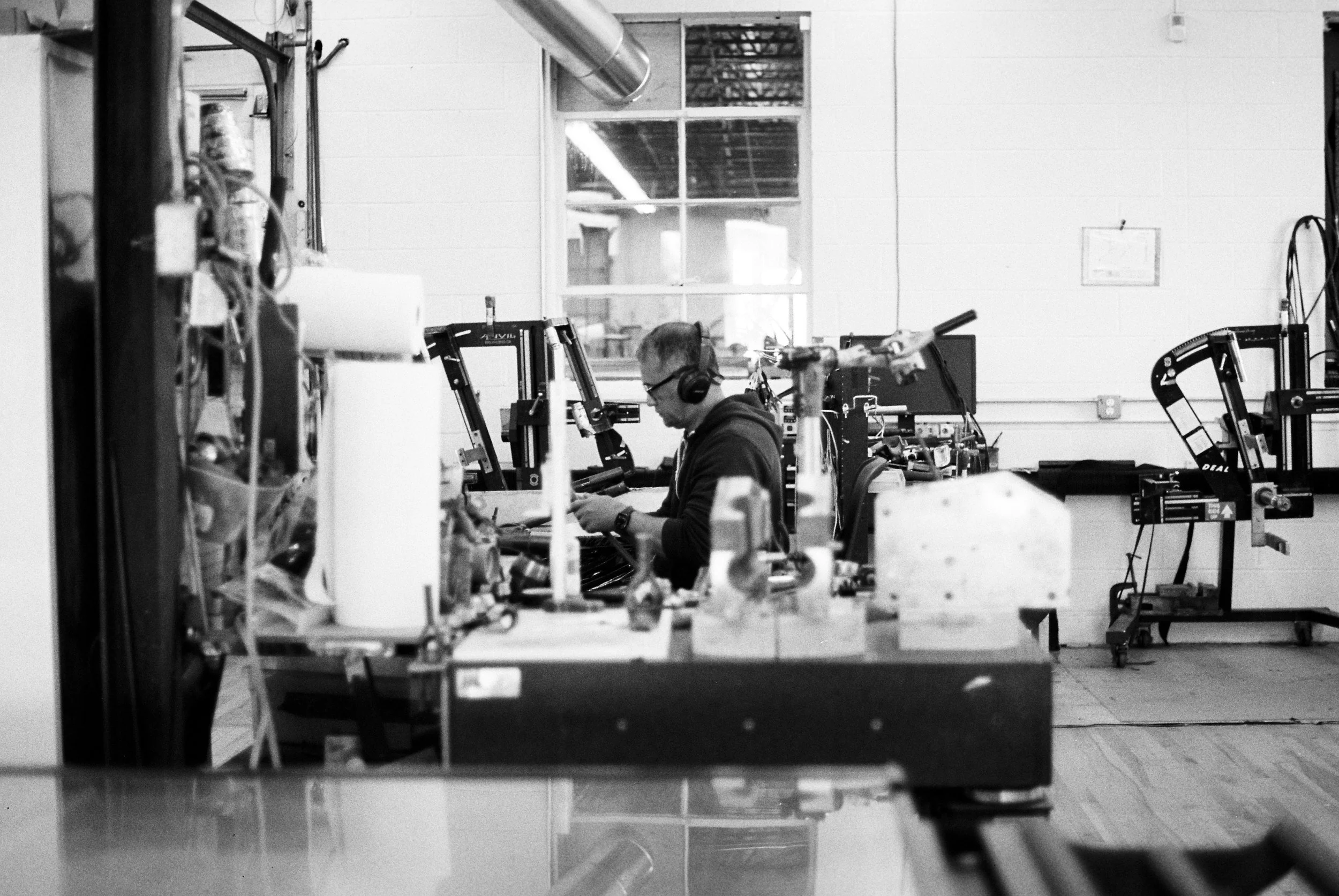
Comfort keeps coming up. Why is it so central to Parlee?
Because roads haven’t gotten any better in the last 25 years. Comfort isn’t the opposite of performance—it enables it.
If you can give comfort without taking away stiffness, handling, or weight, what’s the downside? You stay fresher longer. You maintain power. You keep control on real roads, not just perfect pavement.
How much does New England influence that philosophy?
A lot. The roads alone will teach you some lessons.
Cyclocross was huge here early on. We were riding ‘cross bikes on the road and off-road 20 years ago—long before “gravel” was a word. Weather matters too. We built our first disc brake road bike around 2012, years before it was mainstream, because riding in wet conditions on rim brakes just isn’t great.
There’s also a kind of New England—or Yankee—ethos. Bob used to joke about being a “tight Yankee.” There’s a thoughtfulness about material use, efficiency, not being wasteful. We care about transitions, about not doing things just because we can mold any shape we want.
Bob looms large in Parlee’s story. How do you think about his legacy?
Bob would be the first to tell you it was never just him. His name is on the down tube because he had the chutzpah to start the company, but it was always a team.
Early on, Bob realized he wasn’t best suited to repetitive frame production. He was a tinkerer, a problem solver. He delegated to people who could execute consistently. And he always gave credit.
What I took from him was a willingness to question dogma. Road cycling is incredibly resistant to change. I remember when STI levers were heresy. When people said disc brakes would never belong on road bikes. When clinchers were considered unacceptable for racing.
Bob always asked, “Why not try it?” We still have a corner of the shop full of failed experiments. Tri bikes with no top tube. Test mules that never went anywhere. But bikes are small enough that you can try things. On Monday you have an idea; by Tuesday afternoon you can be riding it.
That experimentation—that curiosity—is a huge part of his legacy.
Your role has evolved a lot over the years. What do you focus on now?
When I started, I worked directly with Bob on fabrication and design—making frames, evolving manufacturing processes.
Around 2006–2007, Bob and Isabel asked me to focus more on the business side. I had experience in tech sales and channel development, and I’d worked in bike shops. So I spent about ten years building the dealer network, expanding distribution internationally, while still contributing to product work.
Around 2017, once the business was more stable, I shifted back toward product management. We started offering complete bikes, not just frames. Today, my role is essentially head of product.
That means managing the entire product lifecycle—what markets we’re in, what bikes we should make, design and concepting, supplier relationships, down to screws and washers. One day I’m sketching a product, the next I’m working with a supplier on a fastener.
It’s a small company, so I still do dealer work, marketing outreach, trade shows. I’m in London for Rouleur Live. Being out there talking to riders and dealers informs the product. You can’t design in a vacuum.
What does the future of Parlee look like in this new chapter?
The vision hasn’t really changed: make fantastic bikes.
One big shift has been moving stock bike production from Asia to Portugal. That wasn’t about tariffs—it was about quality and workflow. As a small company, you’re a small fish in a big pond in Asia. Factories are optimized for price, not the kind of standard we care about.
In Portugal, we’re working in a single-piece workflow, with monthly shipments—much closer to how we operate here in Massachusetts. It lets us manage inventory better and serve dealers more reliably.
John’s leadership has been huge here. He brings deep experience in sales, marketing, operations, logistics, and technology. Bob and Isabel carved out an incredible brand without that background, which is amazing. But having that operational rigor now allows us to focus on what we love—product—without the business side constantly being on fire.
We don’t want to be Trek or Specialized. There’s a wide-open lane for high-end, high-performance carbon bikes focused on quality and personalization. Our job is just to keep making good stuff.
What keeps you excited after all these years?
Bikes are still small enough that you can try things. You can touch the material. You can ride the result.
The best products come from passion. If you care deeply about what you’re making, that shows up in the result. That’s what’s kept me here for over twenty years—and why it still feels worth doing.
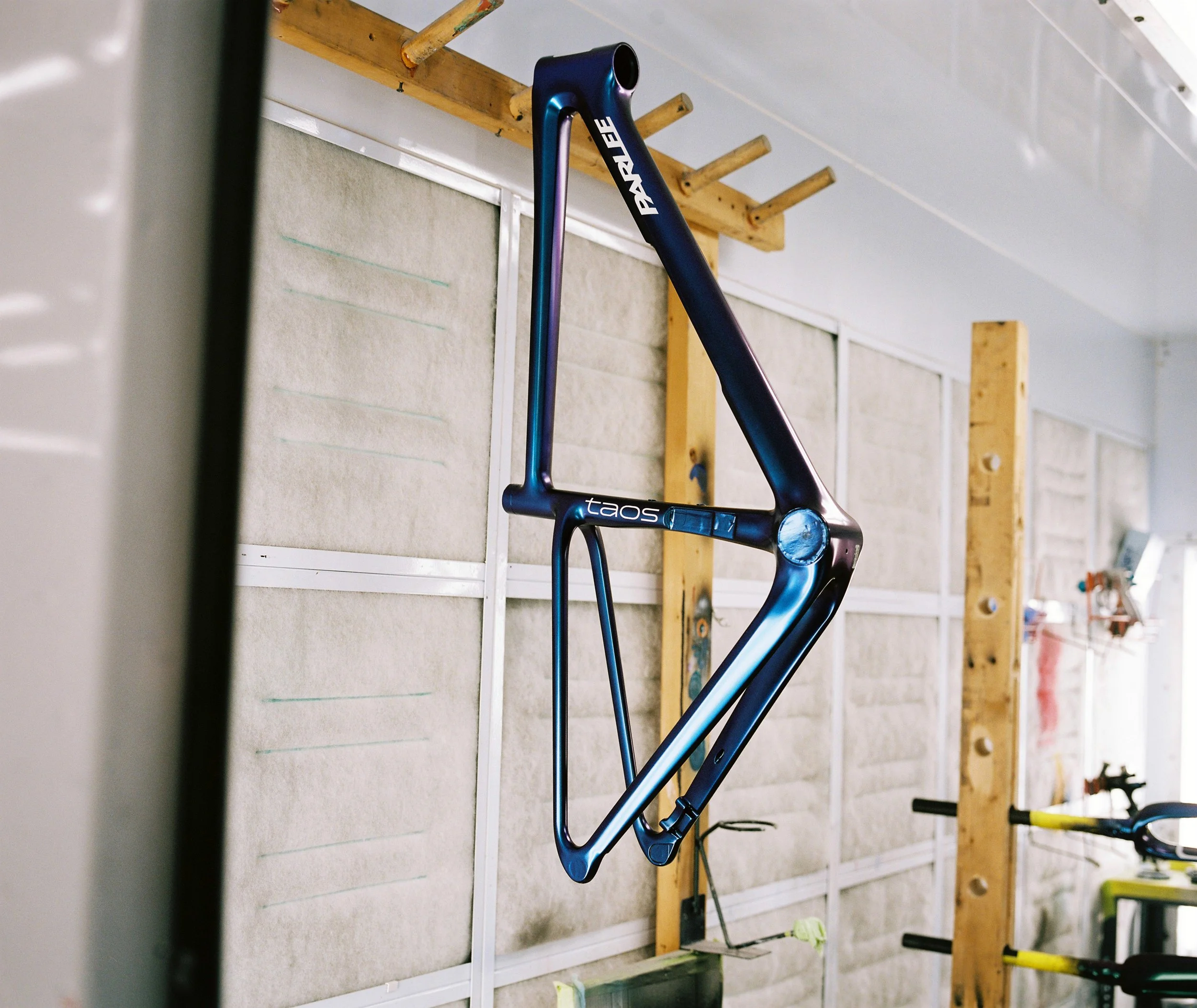
Parlee is a high-performance bicycle manufacturer headquartered in Beverly, Massachusetts.
Written by Chessin Gertler with Tom Rodi | Photography by Chessin Gertler