
Sarah Vogel — Brand & Communication
Evolution | Parlee
“Parlee has never been accessible to everyone from a price standpoint. I don’t think that’s a negative. It’s a byproduct of an uncompromising standard of quality. We use cost-no-option methods, take time, pay attention to every detail, and pursue a sublime ride experience. A perfect carbon finish off the line. And we still do true custom—built around someone’s fit geometry. Parlee is already a dream bike for a lot of people, but it’s not common knowledge. It’s still “if you know, you know.” We want people to know.”
Sarah Vogel is Parlee’s Marketing Manager, joining the company amid a broader effort to clarify and articulate what Parlee stands for. With prior experience at Specialized across both retail and corporate roles, Vogel brings a rare mix of industry fluency and community-focused brand thinking. At Parlee, she is tasked with building the company’s first cohesive brand framework—one that honors its history without being defined solely by it. Her work centers on reframing comfort as performance and translating a deeply experiential product into language without flattening its nuance. In our conversation, Vogel discusses the challenge of making an “if-you-know-you-know” brand legible without compromising what makes it special.
Let’s start with your role—what did you come to Parlee to do?
I joined Parlee in August. It feels like it’s been a lot longer—in a good way. I’m the marketing manager, which means I do pretty much everything: social media, the backend, and what we’ve been working on most intensely—reimagining the overall brand and how we talk about each product.
I came from Specialized in Colorado. I worked retail, then at their corporate office in Boulder doing brand experience—community engagement, local marketing. After moving back to Massachusetts I spent some time in fundraising, but I couldn’t stay away from bikes.
When you arrived, were you inheriting something established, or building from scratch?
A bit of both, but mostly from scratch. Since John took over, pieces of marketing had been handled by freelancers, so there was some foundation. But the big work—core pillars, messaging, rebrand-level clarity across the line—that’s essentially new.
What’s the core problem you’re trying to solve with this brand work?
Communication. Consistency. And awareness.
When someone comes to our website—or hears the name Parlee—we want it to be immediately clear what we stand for. Right now, there isn’t a lot of brand awareness, and even when people have heard of Parlee, it’s not always clear what Parlee is, or why it matters. The goal is consistent messaging across the product line, and across dealers, and across every touchpoint—so someone can actually align with the brand.
Ideally, I want an immediate association: Parlee makes the best bikes in the world.
How are you structuring that messaging? What are the pillars?
We’re still in the process of finalizing, but the core pillars are: Innovation, Experience, Comfort, Craftsmanship, and possibly a fifth: People/Relationships
We’re debating whether we keep it to four or allow five, because relationships really are a major part of Parlee.
Can you unpack those pillars a bit?
Innovation is our engineering—25 years of custom fit data, and the way we build carbon. Our layup is far more intricate than most brands because we prioritize the rider experience above everything.
Experience is the “mysterious sauce.” People ride a lot of bikes and think, “Yeah, it’s a bike.” Then they ride a Parlee and finish the ride almost baffled—like, what just happened? Why did that feel so different? Why did that ride feel better than anything else I’ve ridden?
Comfort is a huge part of that. Our bikes are insanely comfortable. You don’t feel as beat up. You finish your ride and you still feel like a person—your shoulders don’t hurt, you’re not wrecked. It’s kind of crazy.
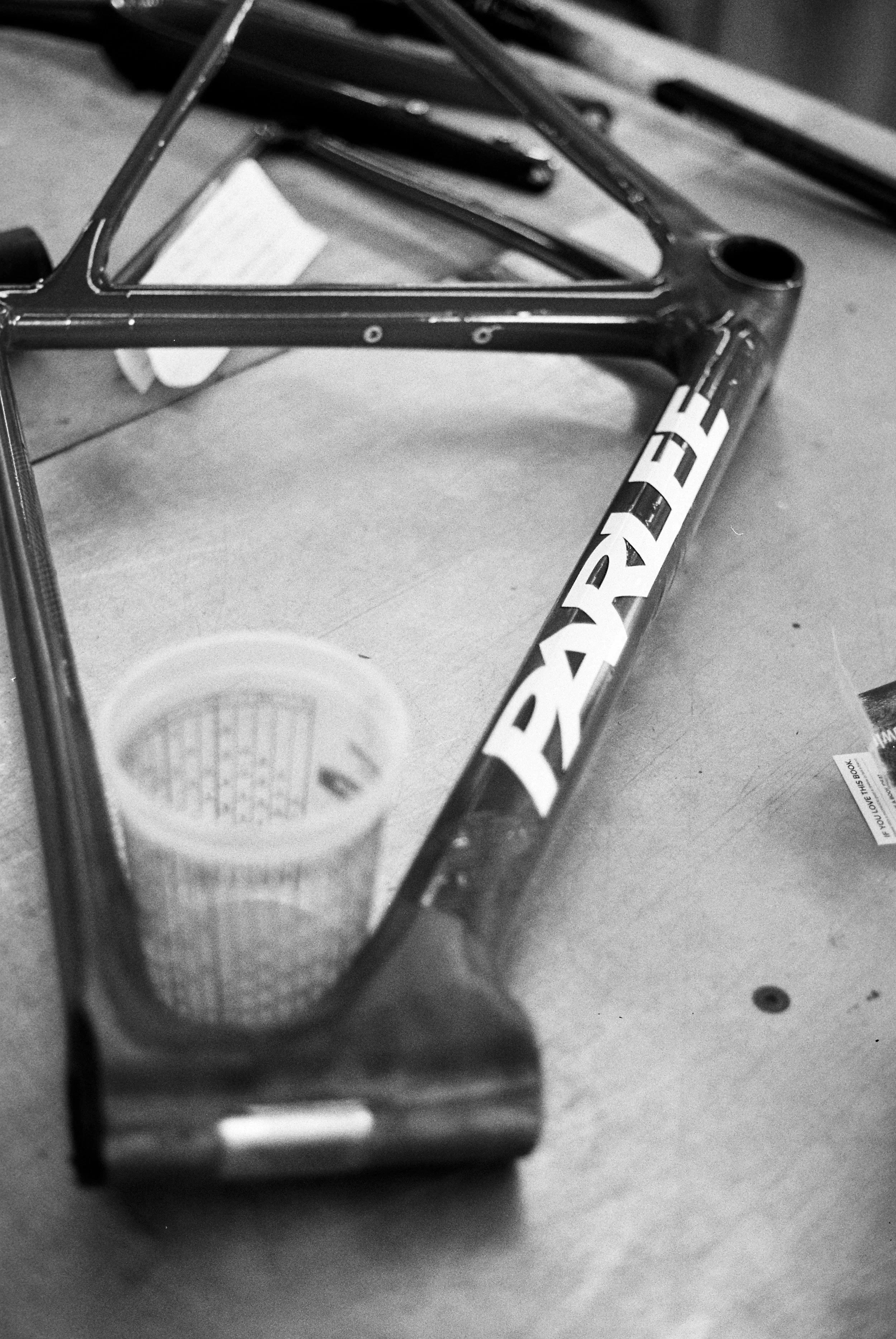
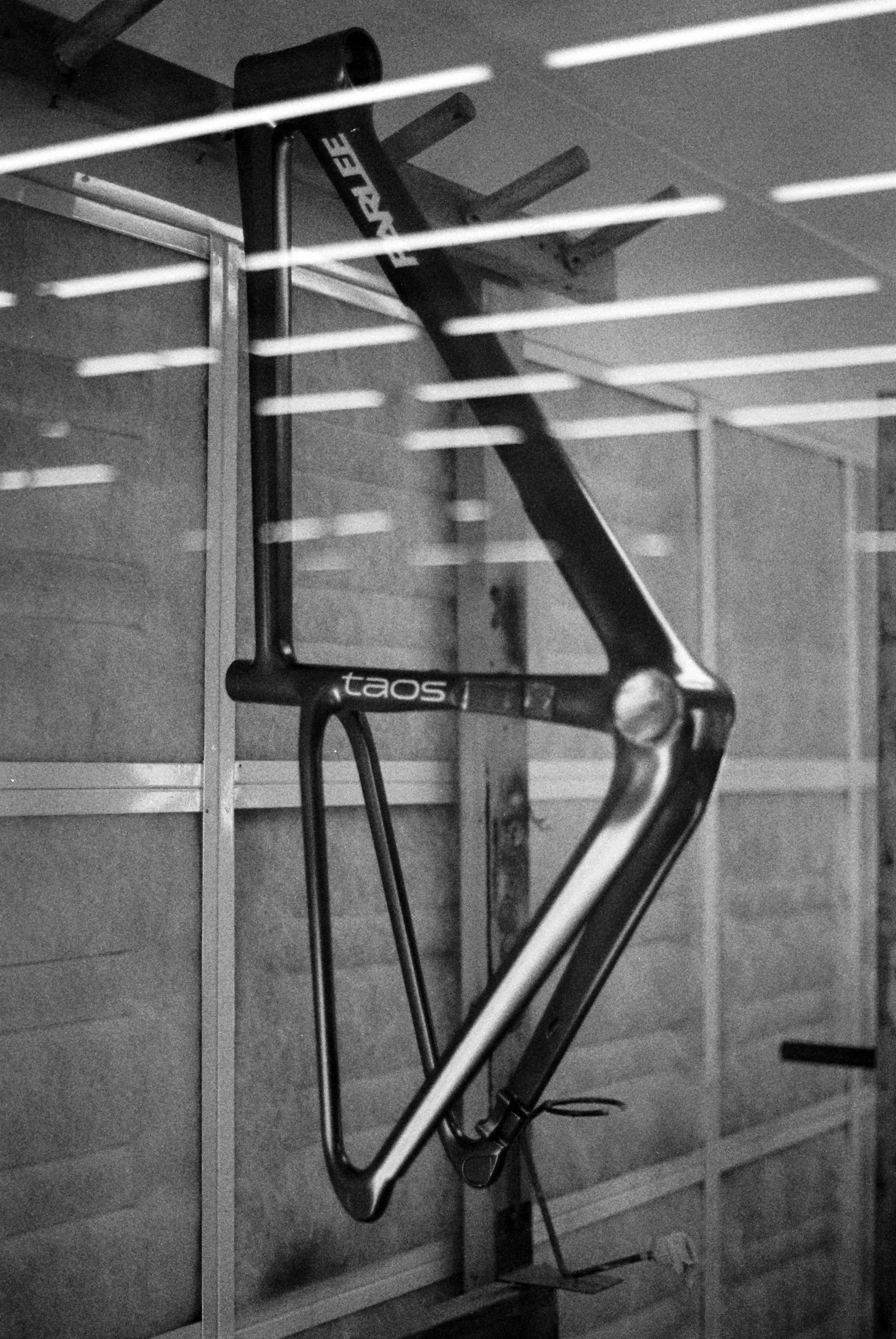
And craftsmanship: everything is handmade. Even the bikes made in Portugal—the production-line bikes—are still made by hand by our manufacturer. It shows up in the quality and attention to detail. You can feel it when you ride them. They ride like a Parlee.
What does success look like for you? Is this about sales, or something else?
Sales matter, obviously—but the primary goal is to improve how we communicate. A clear framework helps us shape product messaging so each bike is an embodiment of the pillars. It makes us coherent—internally and externally.
And it helps solve a real issue: people don’t know Parlee exists, and even if they do, they don’t necessarily know what it stands for.
When you did your initial deep dive on Parlee, how much of the brand was “Bob Parlee,” and how much was the company?
Right now, they’re not very separate. Our website messaging is very focused on Bob Parlee. And of course we want to include the history—this company wouldn’t exist without him. He was a genius in carbon fiber, and he set the foundation for everything.
But defining Parlee as a brand separate from the person is part of what we’re doing. The brand has to stand on its own, anchored in what the company is now—this small team, this collective expertise, the way the bikes are built.
So in a sense, this is about revealing what’s already true—but hasn’t been articulated outwardly.
Yes. I think the lack of that separation—of a clear outward definition of what Parlee stands for beyond Bob—contributed to Parlee being “lost” in a way.
The good part is: we’re small enough that everyone can contribute. We’re having a real internal conversation about what Parlee means, from different perspectives—design, production, sales—and condensing it into something that feels true to the people who make up Parlee.
If this works—fully—what does Parlee look like in five or ten years?
A dream bike brand—widely understood as one.
Parlee has never been accessible to everyone from a price standpoint. I don’t think that’s a negative. It’s a byproduct of an uncompromising standard of quality. We use cost-no-option methods, take time, pay attention to every detail, and pursue a sublime ride experience. A perfect carbon finish off the line. And we still do true custom—built around someone’s fit geometry.
Parlee is already a dream bike for a lot of people, but it’s not common knowledge. It’s still “if you know, you know.” We want people to know.
You’re trying to reframe comfort as performance. Why is that hard in cycling right now?
Because “comfort” became a bad word. People hear it and think of cruisers—upright beach bikes. But comfort should mean maximizing your potential as a rider: more distance, more speed, more volume, more enjoyment. Most people are not WorldTour riders. They don’t need a brutally stiff aero bike. They need something that works on real roads.
Tom said something the other day about the Ouray—our all-road bike—that stuck with me: “For real roads and real people.” That’s exactly it. A compliant frame, wide tire clearance, potholes that feel smaller. Comfort becomes performance for everyone. If your bike isn’t comfortable, you’re not going to want to ride it.
Do you have a personal reference point for how dramatic the difference is?
Yes. I’ve ridden the highest-end bikes from the big brands. My favorite bike I’d ever ridden was an S-Works Tarmac. Then I rode an RZ7 for the first time and I was genuinely shocked. It blows it out of the water.
And the crazy part is: nobody knows.
If the product experience is that strong, what makes it hard to communicate?
It’s nebulous. It’s subjective. It’s hard to quantify.
Tom has a story about this: he and Bob tried to distill “comfort” into measurable components—like, how do you say a bike is X percent more comfortable? They got to something like 25 indicators and it still didn’t cover it. They argued about it, and it kind of became a wash because it’s hard to categorize comfort in a concrete way.
That’s one of the challenges: the experience of riding a Parlee is so significant, but putting it into words—without it becoming vague marketing—is hard.
What do you want to change about who feels invited into Parlee?
I think Parlees have been perceived for a long time as almost too expensive—so people automatically discount them. “That’s not for me.” We don’t want to apologize for quality, and we won’t compromise. That’s completely contrary to who we are.
But we do want people to see someone who looks like them on a Parlee and think: maybe this bike is for me.
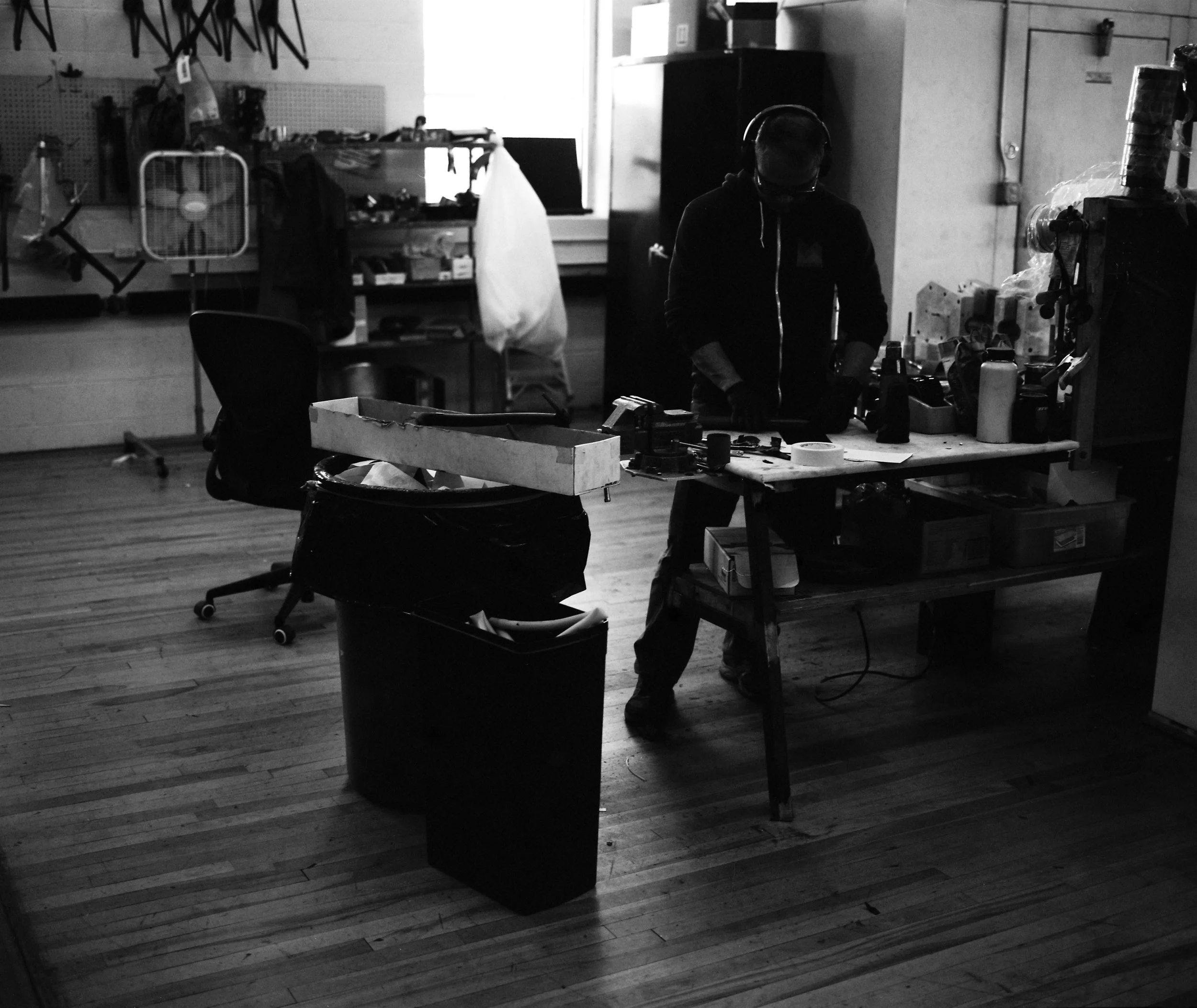
Parlee is a high-performance bicycle manufacturer headquartered in Beverly, Massachusetts.
Written by Chessin Gertler with Sarah Vogel | Photography by Chessin Gertler