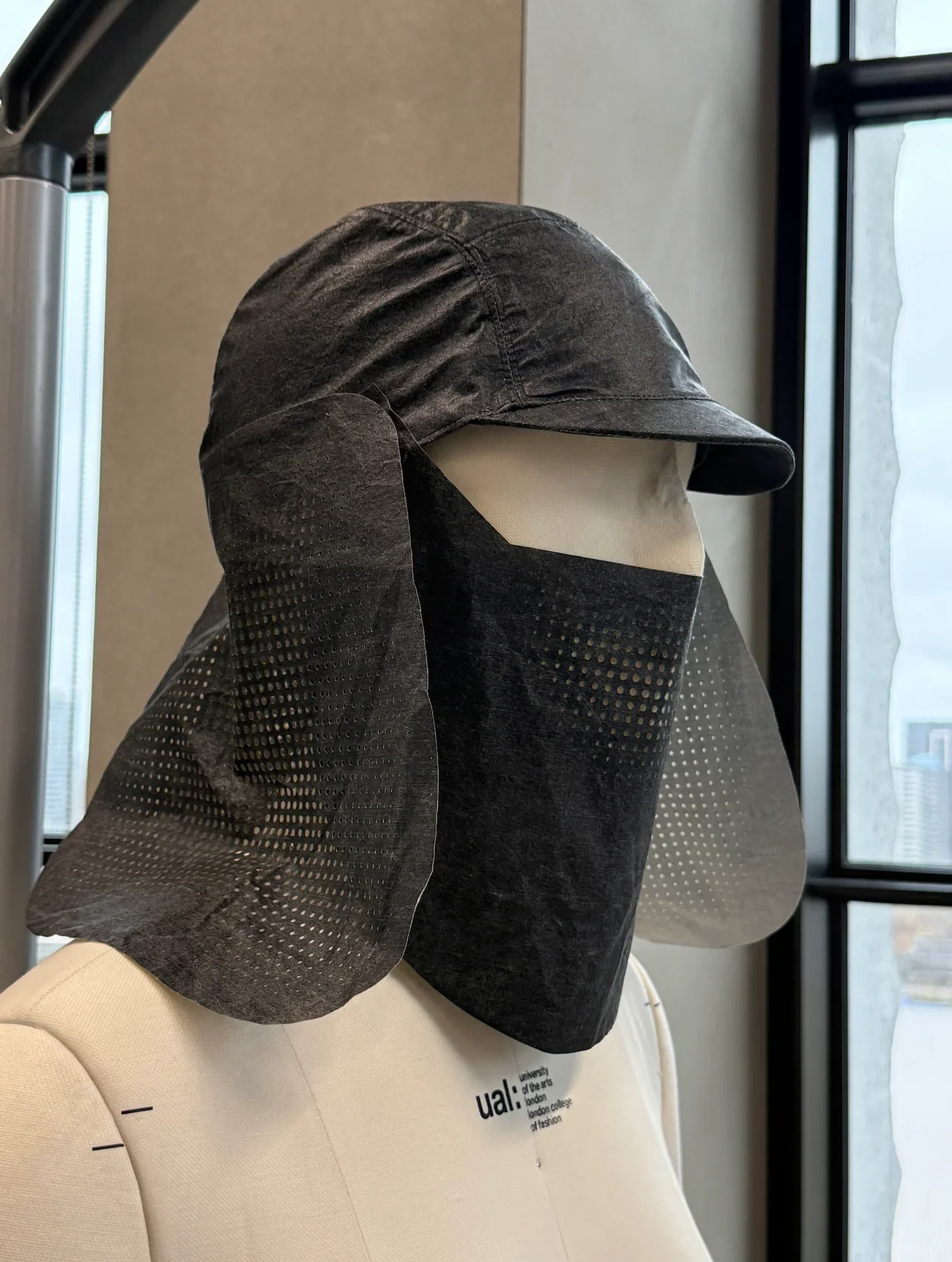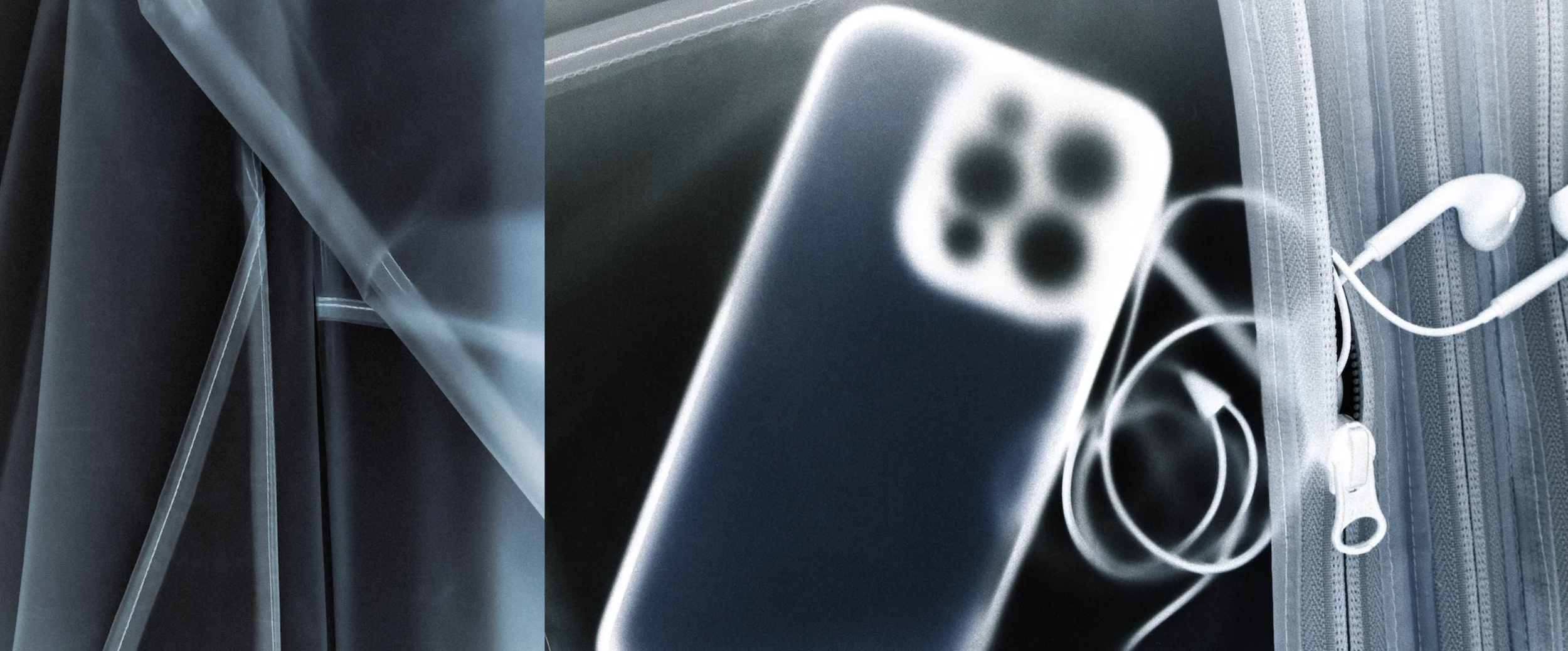
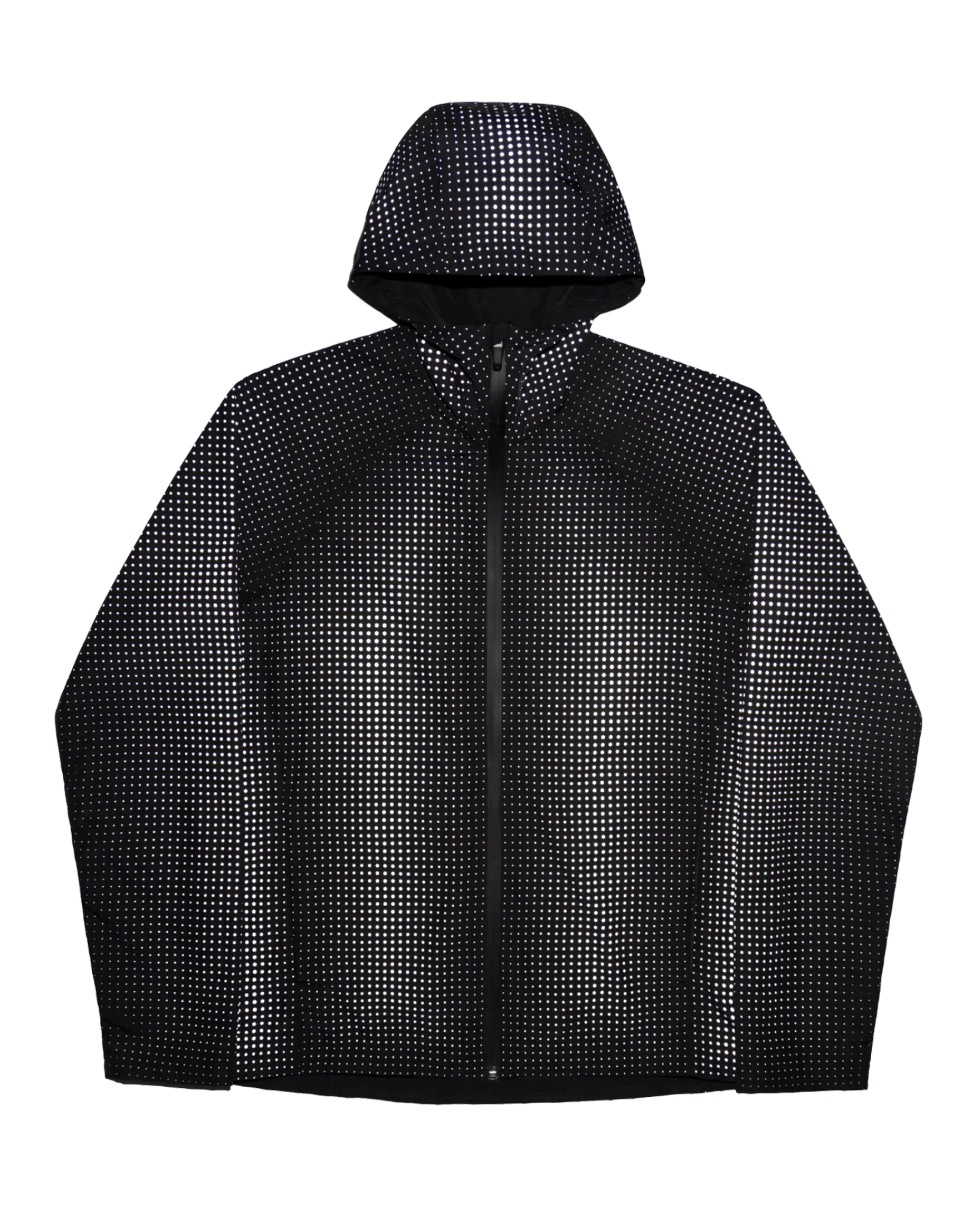
I got hold of L.MILLER’s Perforated Halftone Windbreaker, a black shell over a reflective silver underlayer. Its perforations change in diameter across the garment, a pattern generated using Grasshopper. Miller is 21, raised in the Boston area and now working at Nanoloom and studying fashion sportswear at London College of Fashion after a year at Parsons in New York. He is interested in pushing the boundaries of what clothing can do, and in the processes that bring it into being. His references extend from textile finishes to robotics research; his ambitions are broad. Fashion is his medium for exploring the materials and technologies of the present. We spoke about making things, learning how they work, and where that curiosity may or may not take him.
Chessin
You and I have talked about this shared interest in techwear. Probably worth defining what we mean.
I see it as drawing on motifs from functional apparel: high-performing finishes and fabrics in common silhouettes. I wouldn’t necessarily categorize it as sportswear. It’s stuff you can wear on the day-to-day that performs.
And for you, that started with your dad’s hiking gear.
Partly with my dad’s outdoor collection, and partly from working on a farm. I became interested in wind- and rainproof apparel. A coworkers’ mother was doing work for the military. She gave me my first fabric and my first pattern, and I made a pair of pants for a scarecrow costume. It kind of snowballed from there.
I did a year at Parsons, but it was a lot of drawing and conceptual work. I like the making and the hands-on. They wanted drawings, paintings, sculpture, clay. I was like, I want to own a manufacturing facility.
Sportswear is such a big part of the garment industry. I would have thought there would be more room for that in fashion school.
Fashion schools want to teach you the culture and history behind dress, so you can respond to clothing from a cultural perspective. I wanted to be the person who brings the ideas to life. I like the work that doesn’t get seen. The actual technology and manufacturing is often proprietary, so it’s not posted online.
I found this fashion sportswear course in London. I’d never met someone else interested in sportswear manufacturing. Now I’ve never met so many kids interested in bonding. That alone is a niche thing, but still.
So you are coming at fashion from a technology and manufacturing perspective.
There are a lot of engineers and a lot of fashion designers. Someone who can combine engineering with the actual design is an important niche.
This is a hot take, but in my opinion, there are only so many pockets and silhouettes a fashion designer can make. Where true innovation comes is from materials. As materials innovate, new silhouettes will have to be developed. As technology innovates, new mediums for carrying that technology will need to be developed. If I can move a little upstream of purely fashion design, I can design using that new technology.
And you are already doing some of that through your part-time work?
I’m working at Nanoloom, which is synthesizing its own polymer. That’s what the patents are around. Whatever form that takes is kind of my job. The core product is fiber, but my role is to implement the polymer into actual products.
I connected with one of the engineers who had come out of Central Saint Martins, which is part of the same university as London College of Fashion. I was like, would you want someone who could turn the polymer into products, instead of just showing investors pitch decks?
That brings us to the jacket. You mentioned Grasshopper, which I used in the architecture space.
A lot of my research came from parametric architecture. I use an algorithm in Grasshopper to map perforations. For this jacket, it’s a pretty simple model: the holes get smaller as they get closer to the edge of the pattern piece—the flat piece you sew into a garment.
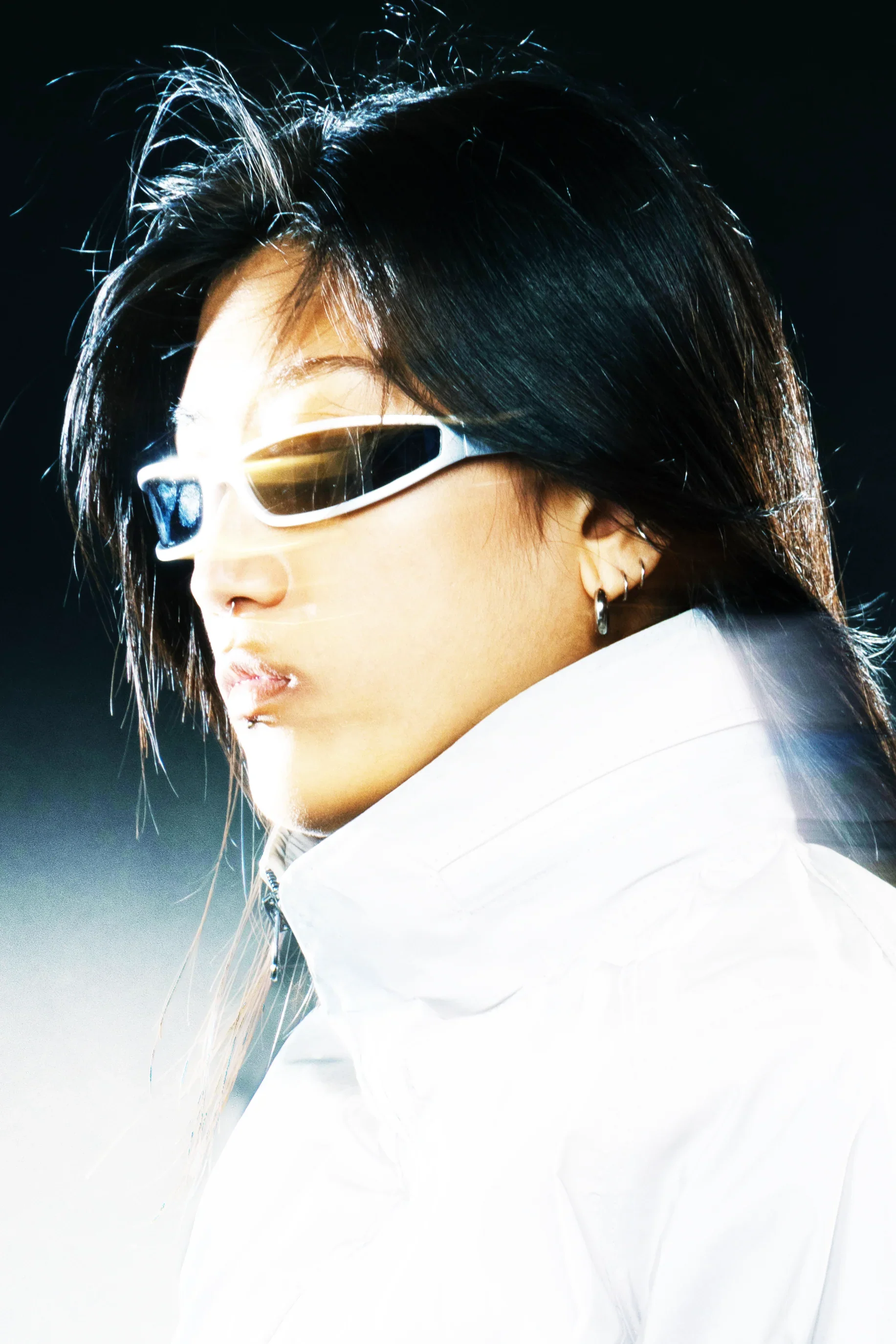
It has a silver reflective underlayer with a black shell on top. I liked that it could look semi-discreet during the day and have a distinct visual identity at night. The main function is the high-visibility detail.
I am looking forward to running and riding in it. Those are demanding uses: it has to breathe while you are working, then keep you warm when you stop.
I’d love feedback. Harsh criticism. One thing my teacher pushes is surveying the user before, during, and after a workout. To be honest, I haven’t done extensive wear tests with it. I see it more as something for day-to-day wear than intense sport, so I’m curious how it performs for you.
And this was the first product you took through manufacturing yourself.
Usually I work through another brand. I design the tech packs—the garment specifications—and hand them over to another person or team who handles the marketing and e-commerce. This was an opportunity to take a product from idea to market.
What have you learned so far?
That tariffs sneak up on you. Even a jacket can be classified differently depending on its construction. Import duties and shipping are things I’d never had to deal with before. At best, I’m hoping to break even and come out with things I can take forward.
The labels I like are interesting in their materials and functionality, but they still reference familiar forms.
There’s a triangle of things you can pull on: silhouette, fabric, and print or color. You can go crazy with the silhouette, or keep it recognizable and innovate with the fabric. Good techwear pulls on one side of that triangle. It gives you something innovative while keeping a familiar product that people can resonate with and hopefully purchase.
C.P. Company does interesting experimentation with textile finishes. Post Archive Faction in South Korea is another brand I look up to.
When I asked about historical influences, though, you pointed me toward MIT Media Lab.
The robotics coming out of there are so cool. They’ve done work with moisture-responsive actuators that open up and allow sweat to evaporate. I’ve referenced research from there for a lot of projects.
Why I look for collaboration so much is that I like bringing ideas to life. A friend and I won a sportswear competition in China with a perforated compression system, using thermal, tension, and sweat data to map the perforations in Grasshopper. He studied industrial design and brings strong ideas and cultural references. I like learning from him. Other people have skills that fill in your gaps.
You seem to spend most of your time making things. Even your free time.
Right now I’m learning electronics, so free time and school are blurry. I’m learning simple circuit-board design and working on a fabric emulator: putting little motion sensors on a textile so I can mimic it in 3D on my computer. I’m just playing around to see what’s possible.
I’m also looking at engineering master’s programs. Mechanical engineering would be cool: thinking methodically, testing, and iterating.
I did not expect you to say that. Is the ambition eventually to have your own label?
I want to do a lot of stuff. I want to be a cook, an engineer, a designer, an electrician. I wish there were more hours in the day. I’d like to lead product development for soft structures, wearables, or clothing. Maybe that’s tents and camping gear. Maybe it’s robotics.
There’s a big cutoff between reality and the technology we use. It’s all on phones and screens. I think there are more human ways to bridge that gap through things we already wear. What if the technology were discreet, and your garment acted as an intermediary between you and the outside world?
The technology of the moment is what excites you. Clothing is a medium through which to explore it?
I like making with my hands. It’s cool what people can do—how we went from apes to microchips and semiconductors. I like learning. I’ll pull on whatever string I can get, as long as I’m learning in the process.
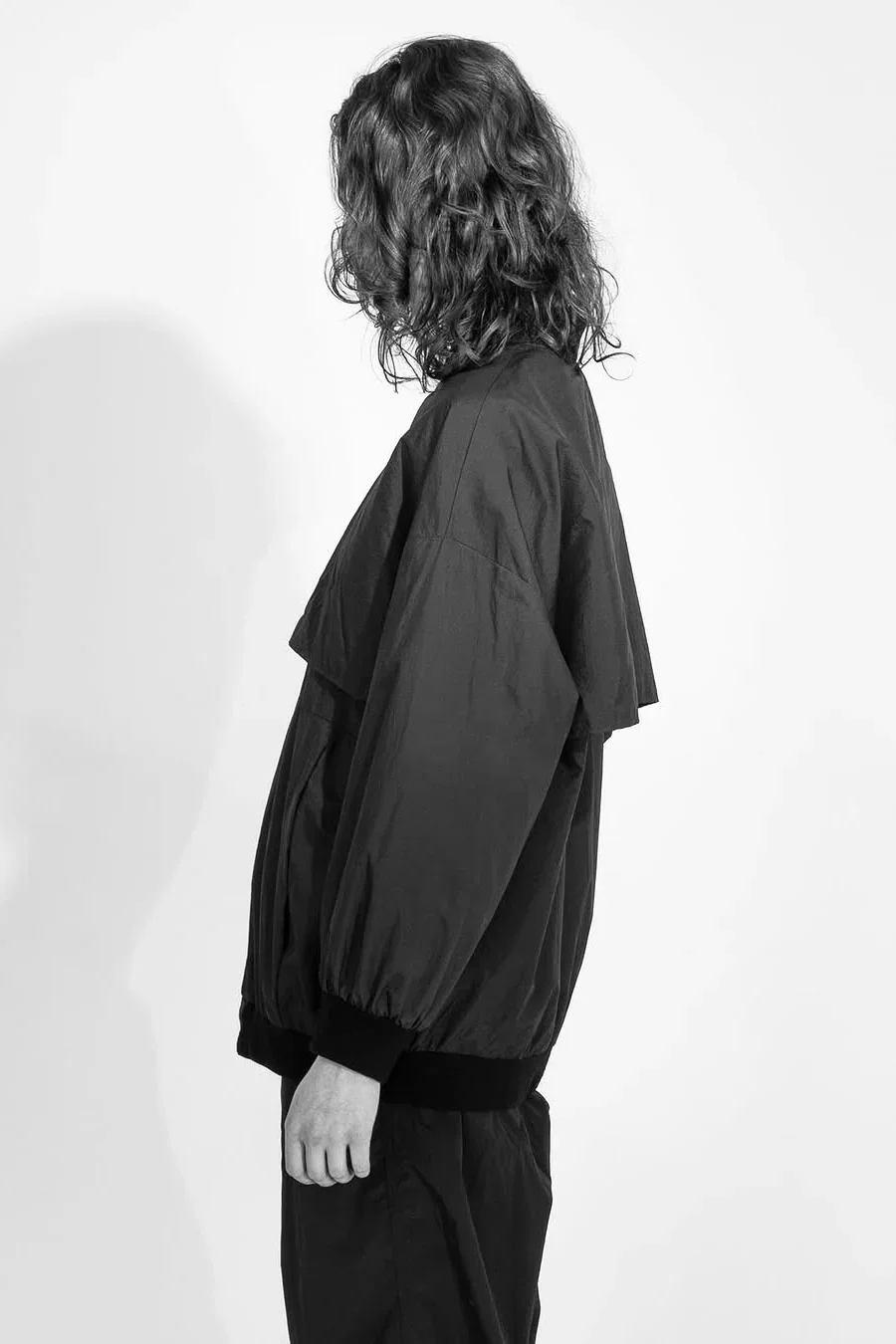
Lucas Miller studies fashion sportswear at London College of Fashion. Working across textiles, manufacturing, and emerging technology, he explores how new materials and methods can expand what clothing does and how it is made. His Reflective Halftone Windbreaker pairs a perforated, water-repellent shell with a glass-bead reflective underlayer for urban visibility after dark.
Conversation transcribed and condensed by Chessin Gertler | Media provided by L.MILLER