
CargoB | Dorothy Fennell
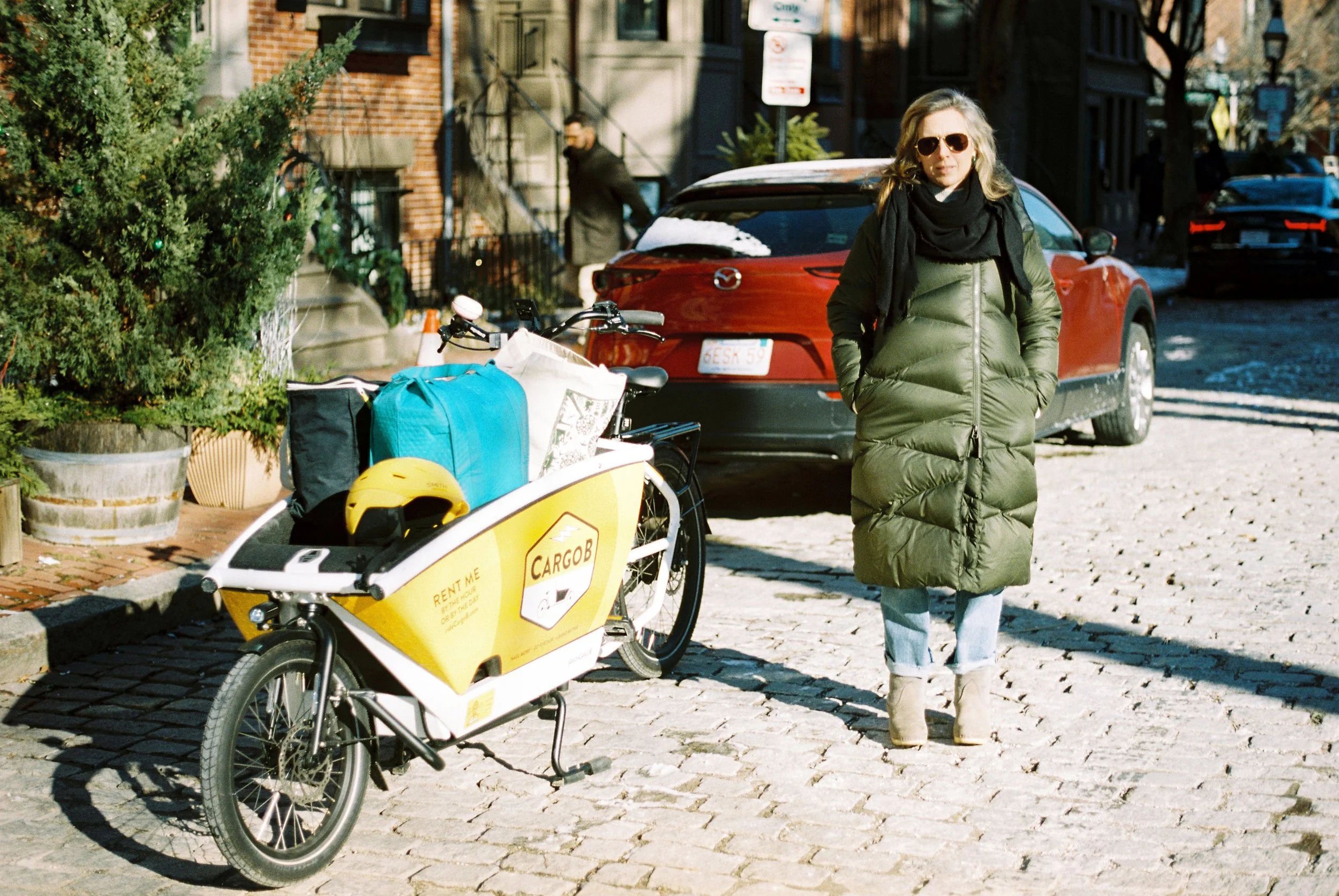
Dorothy Fennell or “Dot” to her friends, knows everyone. In Boston’s mobility, planning, and local politics circles, in small businesses and neighborhood groups, at schools, transit agencies, and community meetings, Fennell moves between worlds often siloed from one another with an impressive grace. She is a superconnector—generous with introductions, thoughtful about who she brings together, and deliberate about the quality of the people and ideas she keeps close. Community, for Dot, is lived, maintained, and actively woven through the built environment.
This perspective is fueled by a uniquely energetic approach and two decades of deep experience in Boston’s transportation, parking, and demand-management policy. Parking policy acts as an invisible lever dictating the pulse of the city, and Fennell has spent years mastering the regulatory frameworks that govern curb management and accessibility. By shifting the focus from the static storage of vehicles to the active management of shared space, she bridges the gap between abstract planning and the tangible realities of how people navigate their neighborhoods.
Fennell has advised large employers, institutions, and public agencies on the disconnect between urban planning and human behavior—specifically why, despite our stated intentions for more walkable cities, people so often remain stuck in their cars. Her work sits at the intersection of workplace commuting, curb management, and last-mile access, effectively translating lofty policy goals into operational reality. Fennell’s perspective is sharpened by her daily experience as a mother of three growing children, navigating school pickups, groceries, and family logistics in a city still largely organized around driving.
Launched in Boston in 2024, CargoB is her response: an on-demand electric cargo bike share designed for short, utilitarian trips—the grocery run, the hardware store, the pickup that doesn’t require a car but could get by on just the trunk space. Through a readily downloadable app, riders access a shared fleet of pedal-assist, non-throttle front-loader cargo bikes built to carry children, groceries, and anything else you can fit. Fennell’s ambition is intentionally pragmatic: to scale CargoB across Metro Boston through partnerships with transit agencies and municipalities, and to show that shared access to the right-sized vehicles can meaningfully reduce car dependence for short trips across the neighborhood—making streets calmer, cities more efficient, and urban living more humane, without demanding ideological buy-in or lifestyle conversion.

What is CargoB?
CargoB is North America’s first electric cargo bike share, pioneering the next generation of urban transit. We are shifting the paradigm for bike-share users by replacing unnecessary car trips with high-capacity, pedal-assist utility—offering the cargo space of a car with the agility of the bike lane.
The short trip.
Exactly. The ones that are under three miles which make up 45% of all the driving happening in this country every day—nearly half of it is for a distance so short that a car is unnecessary. On top of that, 80% of that time, your car is a single occupancy vehicle. We really have to begin to ask ourselves, “could that have been a bike trip?” “what’s standing in the way of making that a quality transit trip?”
Why does that matter enough to build a company around it?
Because when someone tells you it’s hard to get out of their car, you should believe them. I’ve spent 20 years working in commuter transportation in Boston, mostly on workplace commuting—working with large businesses, institutions, business districts. I’ve heard every version of the same truth: I’d like to drive less, but it’s hard.
And as a planner, you listen, but you’re also supposed to come back with solutions. The reality is: people already have a car. It’s not realistic to expect them to buy a new vehicle for every different kind of trip. So why not give them access to a different vehicle as needed—specifically for the short trip?
When you say “different vehicle,” you’re not being metaphorical. You mean: the right-size machine for the job.
Yes. People are just trying to get somewhere. We’ve built our neighborhoods so that driving is often the most convenient option—sometimes the only option. If you have dependents—kids, an older relative—then you’re not only stuck in the car for your own trips, you’re stuck in the car for everyone else’s trips.
And I’m also thinking about how cities say they have goals—land use, economic development, curb management, housing growth—and mobility underpins all of it. If the primary option we give people is cars that take up a lot of space and move the least number of people, we’re not going to reach those goals.
You’re also watching the safety side.
We’re at an all-time high for crashes. People walking and biking being hit by cars and our most vulnerable neighbors–those who might really have no other option but to walk or be on transit like our children and our elders—have the highest incident rates—because we’ve designed communities where driving is the default. I’m not going to fault someone for driving when they’re making the best choice available to them. I think it’s the responsibility of government to give people other options. It makes me question the motives of communities or politicians who talk about protecting our elders and young people but at the same time work against the very interest of these neighbors being able to move around our communities freely precisely because they might not have access to drive. Currently 34% of the household population in Boston is car-free and by 2030, it is estimated that one in five Bostonians will be over 60, increasingly losing their ability to drive a car, compound that with Gen Z and Gen Alpha, are the first generation to grow up with the "on-demand" economy (Uber, Lyft, delivery apps). They are comfortable paying for the service of mobility rather than the asset of a car. This is in addition to being priced out of car ownership. With all of these groups moving towards car-light living, we will need to rethink how we design our cities to facilitate transit, walking, biking and driving.
Which brings us to the gap you see in shared mobility—especially for families.
Shared mobility in the U.S. has left parents out in a lot of ways. Car share requires bringing your own car seat, which is a hassle. Bike share is specifically designed to limit the capacity (and therefore weight) of what you can put into a basket—it does not include kids. These are options you’re excluded from—or priced out of—if you can’t make other arrangements.
And the moment you have children, you’re not just moving yourself. You’re moving other people. You need to plan for the scenario that requires the most capacity—winter, groceries, backpacks, maybe multiple kids. So you buy a vehicle for those 5% situations, and then end up using it for everything.
The “minivan problem.”
Yes. I have a minivan. I also have a cargo bike. Most people are hauling around capacity they don’t need most of the time, because they can’t risk being stranded on the day they do need it.
Cargo bikes are designed for that reality. Kids, groceries, a dog, mulch—anything that fits within the weight limit. They’re not niche objects anymore. The consumer cargo bike market here is booming, and the purchases are driven by families.
And (this matters!) moms are often the ones riding them. Moms are being pushed to solve transportation challenges.
That’s both a market observation and a cultural one.
It’s lived experience. I’ve talked to cargo bike shops—many run by women—and they’ll tell you: moms come in because they’re solving a transportation problem, they need a solution. They’re not buying these bikes because they want a hobby. They’re buying them because they’re trying to make life function.
Tell me about the bikes CargoB uses.
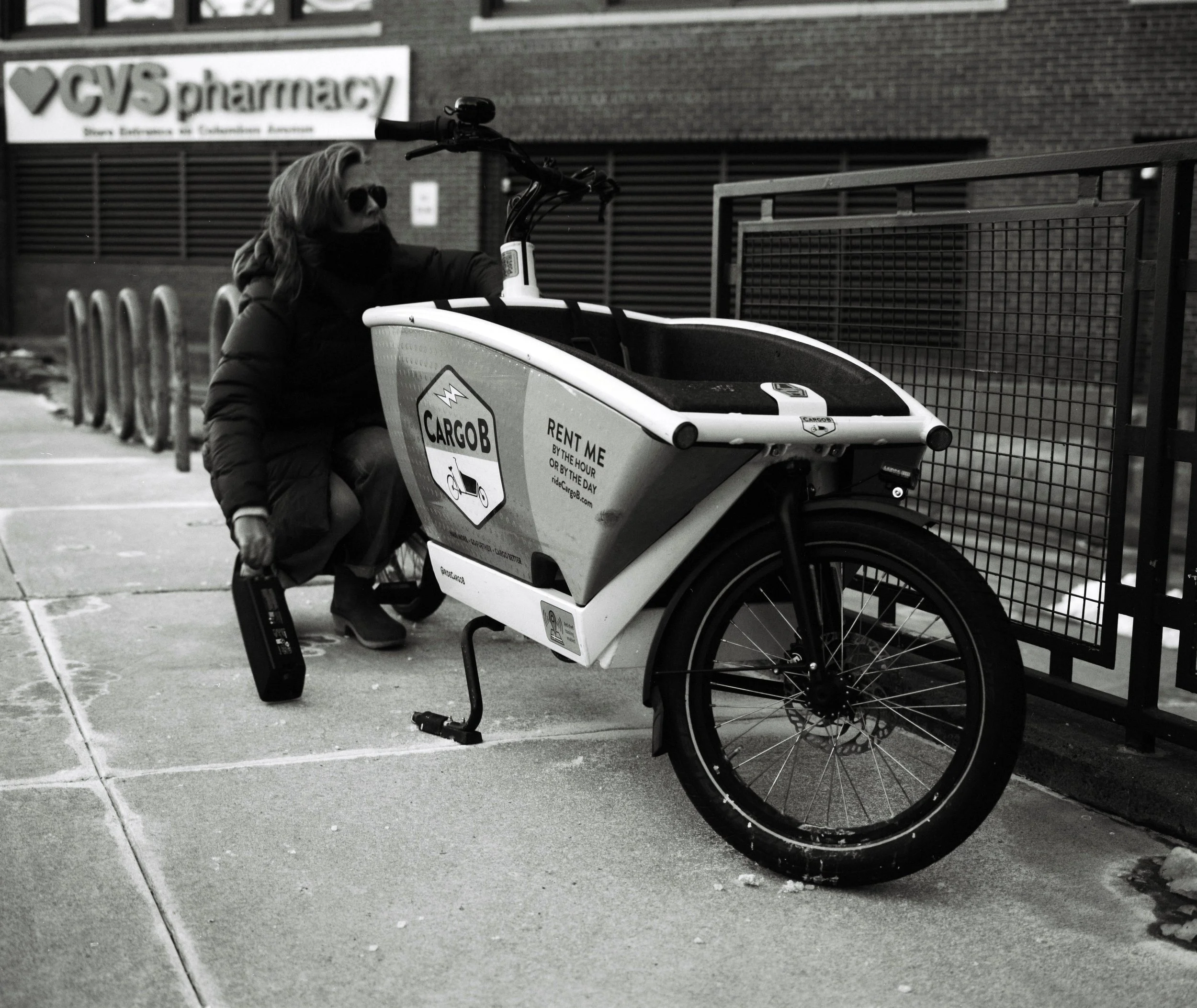
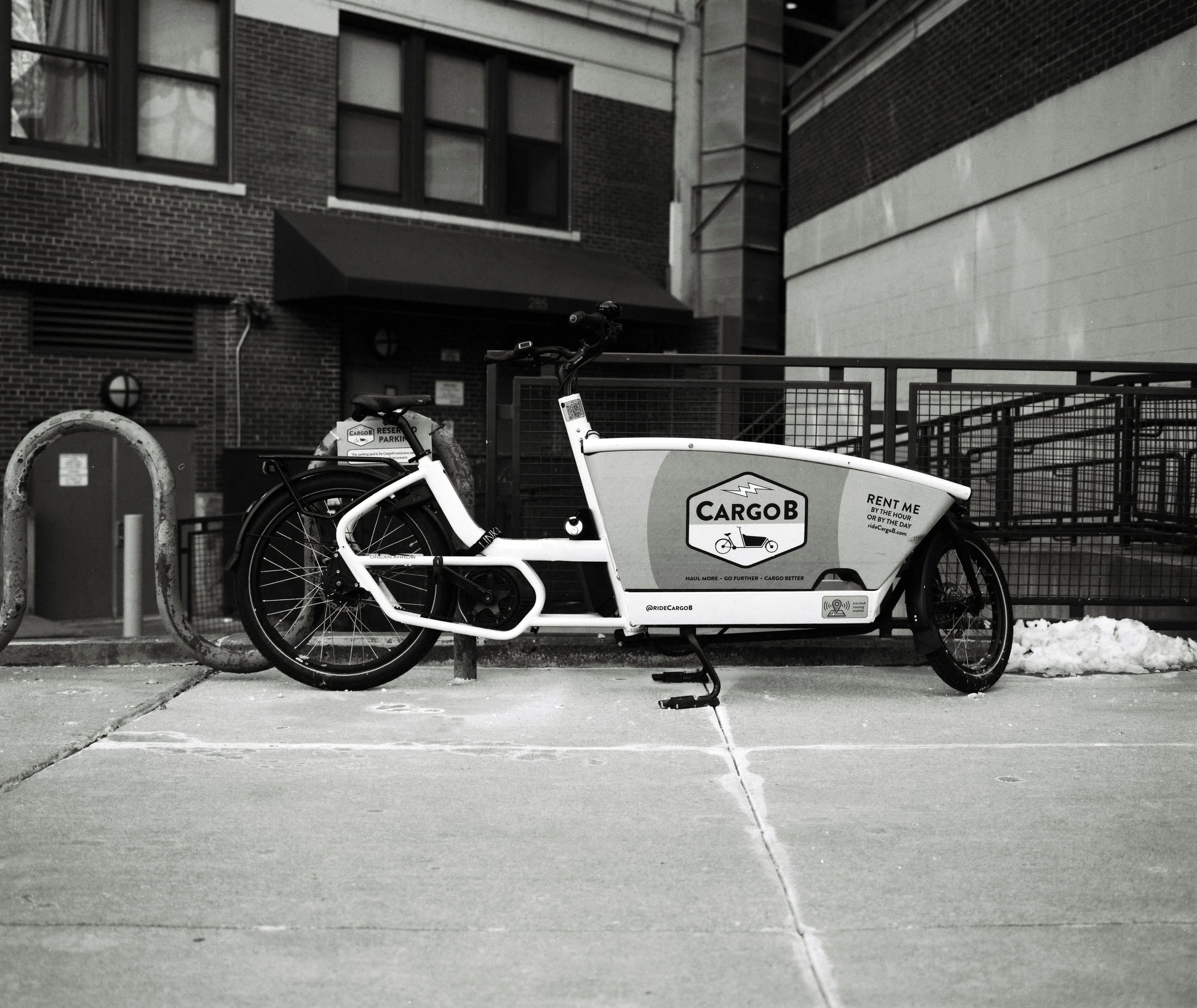
We use a bakfiet—a bucket bike. The back end is like a normal bicycle. The front end is a big bucket. We chose that style because it’s the most utilitarian and least fussy. You don’t have to engineer your life around bags and attachments. Simply load it, hop on and go.
It’s pedal-assist, no throttle. We wanted a controlled ride that doesn’t “take off.” Upright position. Comfortable. Approachable. No need for a specific outfit or limited to a specific lifestyle, cargo bikes are for everyone!
It’s about eight feet long. It fits in standard bike lanes. The handlebars are standard width—what looks big is really the length. And it doesn’t need a car parking space.
How does CargoB work, operationally?
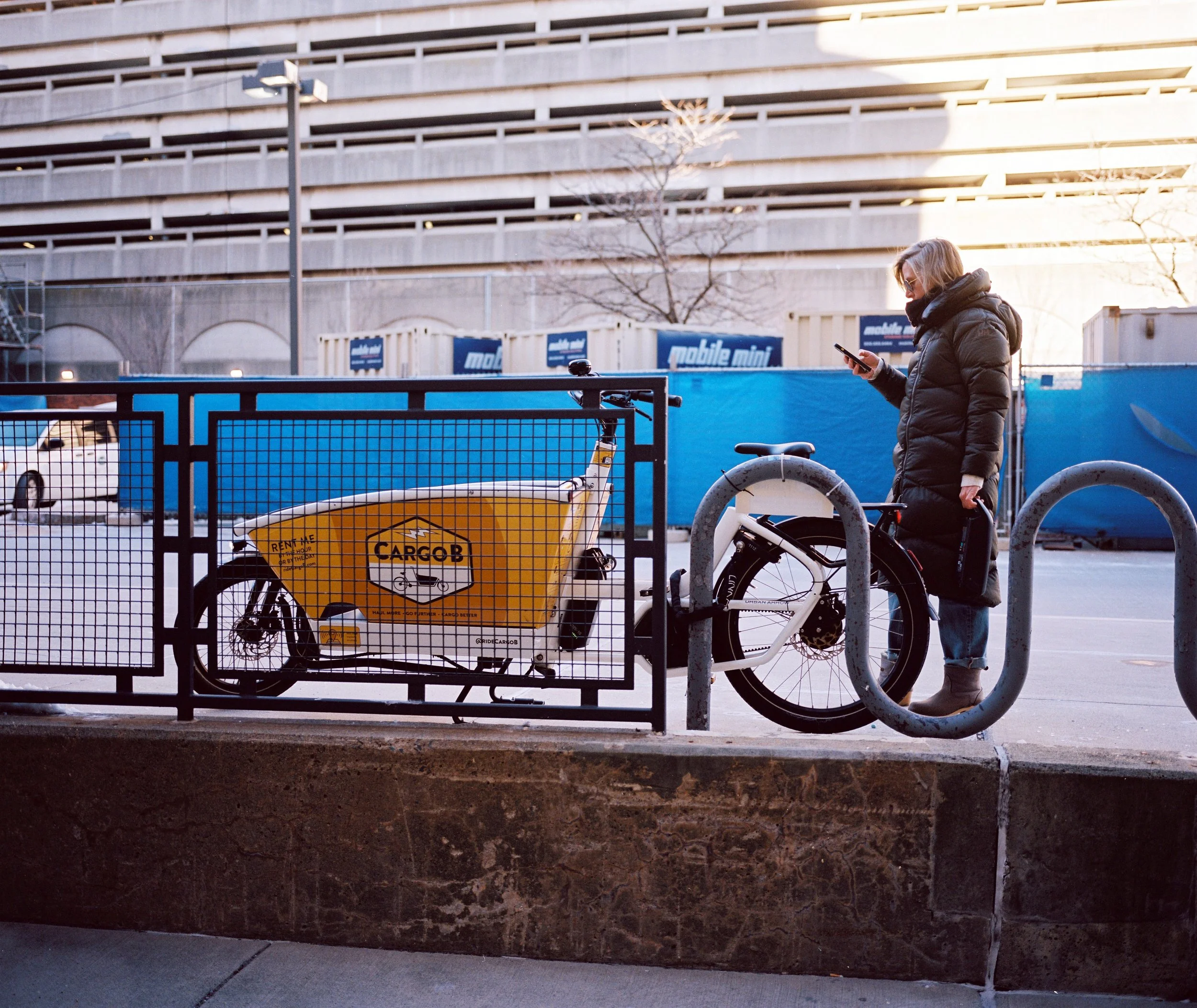
It’s intentionally familiar. App-based. QR code on the bike. Scan, unlock, ride.
Before your first ride you sign a waiver and watch a how-to video—because there are a couple things that are different from standard bike share, like the kickstand and some operating basics.
We’re a round-trip service. You return the bike to the station where it lives. Pay by the minute, with membership packages that reduce the rate.
And we’re serious about being good neighbors. Lock it at a bike rack. Don’t block pedestrians, strollers, canes. The system only works if it fits into the street ecosystem without becoming another problem.
Who is actually using it?
Our biggest user group is 18 to 34. Which surprised me a bit, because we’re not only downtown—we’re in Metro Boston neighborhoods: Arlington, Roslindale, Jamaica Plain, Winter Hill, Porter Square. But this is also the age bracket that is just on the cusp of being pushed into cargo bike ownership if they choose to start having families—so as-needed access works great for this crowd.
The gender split is pretty even, slightly more men right now.
We have around 1,400 people who’ve downloaded the app, and over a quarter are regular riders or have taken at least one ride. The biggest feedback is: “When are you going to be in my neighborhood?”
You hear that as demand, but also as a constraint.
Exactly. With a fleet of 14 bikes, scale is the challenge. People will walk or ride about half a mile to get to us—which is similar to how far they’ll go for a Zipcar. Beyond that, it becomes a hassle.
So our goal is to get closer to where people live as we grow.
And the trips themselves—what are people actually doing?
Grocery runs. Household errands. Yard work. Home Depot. Furniture. Things that would normally require a trunk—but if you can avoid a whole car, even better
Child transport is not the majority of trips. A lot of parents end up buying their own cargo bike because they use it often enough. But parents do use us—tourists with kids, people whose a bike is in the shop, families visiting from out of town and they need a spare vehicle for the weekend.
And then you have the fun stuff: Christmas trees in the bucket. Someone ratchet-strapped long pieces of wood. IKEA furniture sticking out the front. We’ve had people use it for film equipment. And yes—someone used it as a wedding getaway vehicle. I like to say, “if it fits, you can CargoB it”.
Talk to me about the experiential shift. The thing that happens psychologically when someone replaces a car trip with a bike trip.
When people drive around Boston, nobody is fondly reminiscing about sitting in traffic and white-knuckling their way through it. It’s not fun. It’s a means to an end.
A lot of customers come in thinking: Will this save me time,? Will it save me money? That’s the motivation.
But once you’re on a bike, you realize you can move through different parts of the city. Parks become greenway networks. You can pivot mid-trip. You can stop. You spontaneously run into a neighbor. You’re not as stressed.
Would people call it “joy”? Maybe not. They might just say: “That was better.”
And even if it’s once a week, once every other week—collectively it adds up.
You make a claim that feels almost forbidden in American urban life: that fewer cars makes things better even for the people who still need to drive.
Yes. There are many people who truly need to drive. The way you help them is by getting everyone else—who doesn’t need to drive for this trip—into other options.
That makes streets calmer. It makes room for street trees. It makes everything more efficient. It makes it easier for emergency vehicles to move. There’s a domino effect.
I’m here to play the long game. Cultural shifts take time. And I think we’re on the brink of watching that shift really take hold.
Let’s push that long game. If CargoB becomes wildly successful—what changes?
We can’t buy our way out of the climate crisis. Capitalism is not going to save us. Scarcity mindsets don’t help.
I want a world where we’re no longer angry about other people’s mobility choices. Where we have shared access to options—and we can see the collective benefit.
In Boston, you see it in the bike lane debates: “Nobody rides bikes.” “It’s too cold.” “This takes space from cars.” People frame it as a personal loss.
I want the driver to say: “I’m glad there’s a bike lane next to me, because everyone who wants to get out of their car can. Now it’s easier for me to move in my car.”
I’m not here to fight. I’m here to offer something that works. You don’t have to own it. It’s there when you need it. Because what we’re currently doing—sitting in traffic—is not working.
Why is Boston a good proving ground?
Boston is an innovative city. We’re first for quite a few mobility things. We do deep tech—and we also do simple things.
CargoB is simple. And it might take an innovative city to adopt it early.
We have real congestion challenges. We’re compact. We have university campus density. We have administrations that have been committed to creating alternatives and making them viable. Somerville, Cambridge, Brookline, Boston—there’s real commitment to transportation options.
It’s a good place to test something like this because the scale is manageable, and the need is obvious.
Where do you want to take the company, concretely?
We have six-month, 12-month, two-year, five-year goals.
Right now, we have a contract with the MBTA and placed five vehicles across five stations this fall. We see the T as a leader in last-mile mobility, and we’re excited to expand across the system—ten more stations in 2026.
We launched a pilot with the City of Boston: managing three longtails they own and adding one of our bikes—so there’s a fleet of four for City Hall staff to bring the business of government out into the community. Libraries, community centers, parks, events, listening sessions—with supplies. We hope to continue to learn from this pilot in 2026.
Within the next year, we want to expand in Boston, Somerville, Cambridge—and explore what it looks like to put vehicles on public property.
Within two to three years, we could saturate Metro Boston—Arlington, Somerville, Cambridge, Medford, Brookline—and then expand to other cities with strong bike share and cargo bike markets.
My background is transportation demand management. I see CargoB as an intervention, a curb management strategy—shifting access to vehicle types so people can change not just commuting, but all the trips they take.
Make the pitch to someone who’s curious but hesitant.
Don’t be intimidated.
We chose an upright, comfortable position. Non-throttle pedal assist, so it doesn’t jump out from under you. If you’ve ridden shared e-bikes, it’ll feel familiar.
Watch the how-to video so you understand the basics: turning it on, using the kickstand, etc...
And use a coupon to take a low-stakes test ride. Our main one is CARGOBUDDY. 15 minutes. Go to a quiet area, ride it around when you’re not in a rush. Once you feel it, you realize it’s just a normal bike—slightly longer.
You’re a mother of three. You’re also a new entrepreneur. What do you think that combination lets you see?
In my twenty years as a transportation planner—and as a mother of three—I have spent a career studying the "urban friction" that keeps people stuck in their cars. While standard bike shares have successfully achieved a 35% reduction in car trips, we’ve hit a glass ceiling: these systems lack the cargo capacity required for the trip-chaining that defines modern family life. By introducing electric cargo bikes into our transit mix, we can target an additional 15–20% of trips that currently require a car, but don't actually need one.
We have to be honest about who is currently bearing the burden of this inefficiency. Household logistics and child management—the trips that require a "trunk"—are disproportionately managed by women. When our mobility infrastructure fails to account for this, we aren't just missing a market; we are structurally forcing caregivers back into 3,500-pound vehicles to accomplish human-scale tasks. CargoB (the cargo bike, in general) right-sizes the vehicle to the trip, giving users the convenience of the bike lane and the capacity of a trunk. There is a reason why in the $860M and growing US consumer cargo bike market, the largest consumer base is women. The math is simple, but the impact is profound: shifting just 15% of short, cargo-dependent trips to cargo bikes in cities can reduce overall city traffic congestion by up to 30%. We aren't just offering bikes, we are offering the infrastructure necessary to move our cities toward the walkable, livable future we all say we want. And this is the kind of interwoven perspective I’ve gained over the last 20 years as a woman, and now mother, in working in transportation policy.
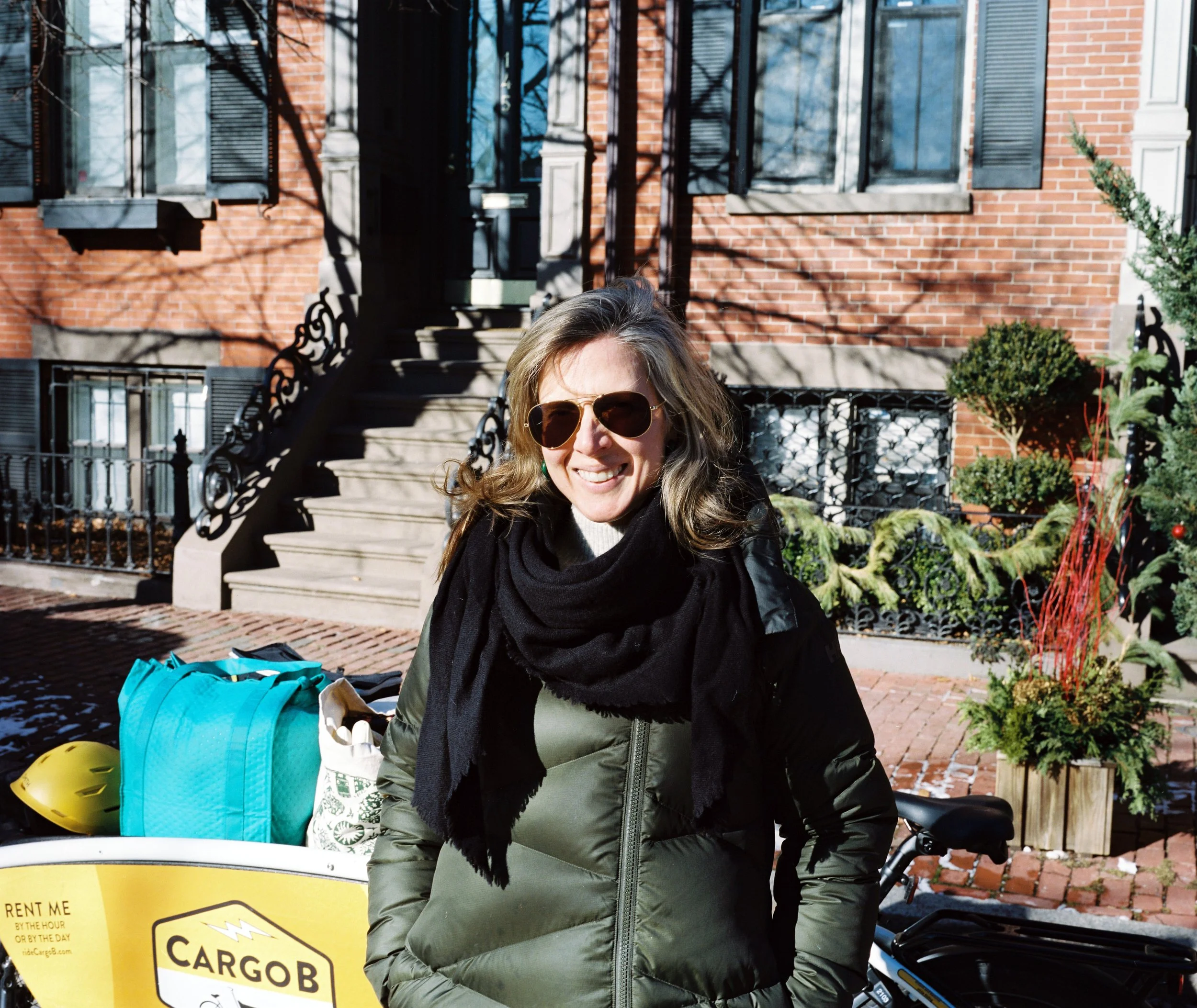
Dorothy Fennell is the co-founder of CargoB, an on-demand electric cargo bike share launched in Boston in 2024 to serve short, everyday trips that don’t require a car. Dorothy is particularly interested in how rethinking automobile dependence and shifting towards multimobility sets a community up for success. Growing up in a multigenerational household with grandparents that either never learned to drive or eventually lost the ability to do so, Dot saw early on that communities heavily designed around car-mobility limit opportunities for independence for those who can’t drive. Dot firmly believes we don’t have to choose between building prosperous, climate resilient cities and having agency over our own personal mobility. We can actually have both via a different type of vehicle, shared electric cargo bikes, that are right-sized for urban living!
Written by Chessin Gertler with Dorothy Fennell | Photography by Chessin Gertler